Monthly Archives: March 2015

Does diagramming sentences help a child learn grammar?

Diagramming sentences is no longer taught in most schools. Like cursive writing, it has been supplanted in the curriculum by computer-related skills and critical thinking skills which for most children are more important.

Yet diagramming offers children a fun way to learn grammar and parts of speech which themselves are not focused on as much anymore, and which has led to poorer writing and difficulties on parts of the SAT (my opinion).

What is diagramming? Diagramming is a visual way of showing the grammar in a sentence, everything from subjects, predicates and clauses to prepositions, subordinate conjunctions and gerunds. If a child can draw a straight line, he can diagram a sentence. And if he can diagram a sentence, he can “see” the grammar.
diagram of a sentence

For example, take the uncomplicated sentence of “The baby noisily slurped mashed bananas from a spoon.” It can be diagrammed by first drawing a horizontal line where the main parts of the sentence are written (similar to the trunk of the human body). All the nonessential information is written on slanting lines under the main line (much like appendages of the body).

On the line to the left always goes the subject of the sentence (in this case the word “baby”). A vertical line cuts through the line to show the end of the subject and the beginning of the predicate.

The first word of the predicate in a diagram is always the verb (in this case the word “slurped”).

If there is a direct object (in this case, “bananas,” it is written to the right of the verb and separated from the verb by a half line which does not cut through the horizontal line.

Prepositional phrases are put beneath the word they describe, with a forward slanting line for the preposition (in this case, “from”) and a small horizontal line for its object (in this case, “spoon”).

Adjectives and adverbs are shown beneath the words they describe on forward slanting lines.

The grammar of much more complicated sentences can be shown through diagramming. Doing this helps children see that a particular “sentence” has no verb, or that the reason a particular prepositional phrase sounds funny is that it needs to go next to the noun it describes. When students learn that subjects or objects can themselves be clauses, a diagram can make this clear faster than a long-winded explanation from a teacher.

Many handbooks on English grammar contain chapters on diagramming, showing examples of various types of sentences. If your child is struggling to learn grammar, using those handbooks might make grammar visually intelligible the way a table, chart or Venn diagram makes data more easily intelligible than a paragraph of explanation.

But don’t expect your child to come home from school with diagramming homework, as I once did. Most of the young teachers today don’t know any more about diagramming than does your child.

Avoid using adverbs for better writing

When we are in elementary school, teachers tell us to use adverbs. When we reach high school, teachers tell us not to use adverbs. What’s going on?

First of all, what are adverbs? Adverbs are parts of speech which describe verbs, adjectives, adverbs and whole clauses. Most of them end in –ly, such as quickly, obediently and awfully. (But not every –ly word is an adverb.) The most commonly used adverbs do not end in –ly and include words like not, seldom, never, today, very, more and less.The –ly adverbs are considered weak words by many writers because they tell, not show. For example,

  • Weak: The toddler walked quietly to bed.
  • Stronger: The toddler tiptoed to bed.
  • Weak: That baby is very tired.
  • Stronger: That baby could hibernate all winter.
  • Weak: The awfully pretty child looked at us flirtatiously.
  • Stronger: The dainty child beguiled us with her smile.

In each of these three examples, a weak adverb is replaced by a stronger, specific verb or adjective.

Another reason writing teachers say to avoid adverbs is because using them weakens ideas. The word “very” is a good example. In almost every sentence you can think of, when “very” is used as an adverb, the idea becomes weaker.

  • It’s very chilly out.
  • It’s freezing out.
  • That cake is very tasty.
  • That cake tastes delicious.
  • Rex is a very well-behaved dog.
  • Rex behaves well.

Some adverbs state the obvious. “The boy fell down.” Can a boy fall up? “Grandma hollered loudly.” Can Grandma holler softly?

We need some adverbs. We don’t have negative versions of most verbs, so the word “not” is the way to make most verbs negative. “Yesterday,” “today,” and “tomorrow” provide crucial time information, as does “now” and “then.”  When we are organizing an essay, sometimes it makes good sense to start paragraphs with words like “first,” “next,” and “finally.”

As a general rule of thumb, adverbs which end in –ly are less organic to writing and should be eliminated or rewritten with stronger verbs. Adverbs which don’t end in –ly are harder to dismiss and might be essential to good writing.

In a narrative, what comes first when you write a reaction to an incident?

Someone steps on your toe. What comes next?

a. You say “Ow!”

b. You feel pain.

c. You withdraw your foot.

d. A, b and c happen at exactly the same time.

In real life, d might seem like the right sequence since our bodies’ nervous systems react so quickly that it might be hard for us to distinguish thousandths of a second meaningfully.

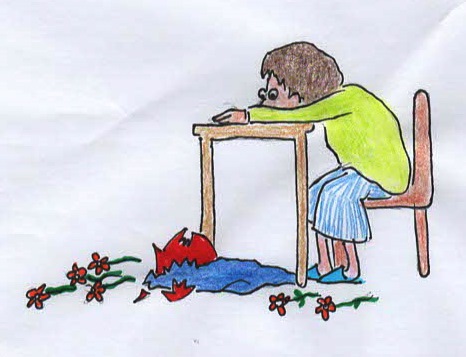
A dog pulls table cloth, knocking down a vase of flowers a woman is working on.

Stimulus

But when we write about this experience, order does matter. Why? Writing is a means of communication based on putting one word after another. Writing is based on sequencing ideas. We can’t write about two things happening at the same time without first naming one idea, and then using a word like “simultaneously,” and

Woman is dismayed

Emotional reaction

then naming the other idea. One idea has to be expressed first and another has to wait its turn.

Knowing this, good writers have developed an order in which to express reactions, and it is this:

  • Something happens (the stimulus).
  • Someone has an emotional reaction.
  • That same someone has a physical reaction based on his emotional reaction.
  • That same someone speaks or not based on a rational reaction.

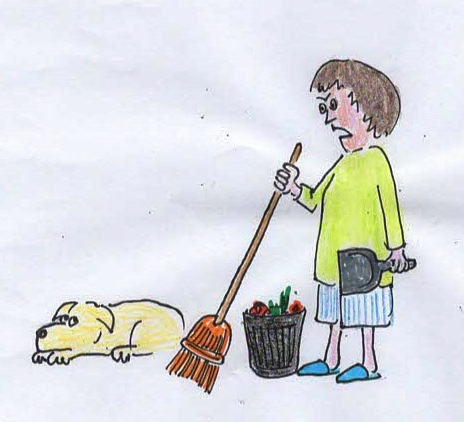
    Woman lowers her head, discouraged

    Physical reaction

If, for example, a raccoon walks across the deck while the family dog is watching from inside the house, the order of action and reaction is

1. A raccoon walks across the deck (the stimulus).

2. The dog sees this and has an emotional reaction of protection. “Hey, this is my territory. Mine, not yours!”

3. Aroused, the dog jumps up and

4. The dog barks.

The woman yells at the dog.

Spoken reaction

Knowing the order of responding to a stimulus is an advanced writing skill, but one that some fourth and most fifth graders can learn. One way to teach this skill is to show four index cards with pictures on them. One might show a raccoon on a deck. Another might show an aroused dog, his eyes bulging (or the way cartoonists sometimes do, with a lightbulb over his head). The third might show that same dog lunging toward the window, and the fourth might show the dog barking at the raccoon.

Another way is to show a series of poorly written reactions to stimuli and to ask the student to rewrite the sequence in a better order.

One warning: Not all four parts of this stimulus/reaction sequence need to be used. A stimulus is necessary, and an emotional reaction is necessary (although that emotional reaction could be trivial if the stimulus is not important). Sometimes a physical reaction will occur, and sometimes not; sometimes a spoken reaction will occur, and sometimes not. The more serious the stimulus is, the more likely all four parts of the reaction will be present.

Use active verbs, not passive verbs, to improve your writing

What are active verbs? In a sentence with an active verb, the subject does the verb.

  • “The cat licked her paw.” In this sentence, the cat is the subject, and it is doing the licking.
  • “Lee ate a sandwich.” In this sentence, Lee is the subject, and Lee is doing the eating.
  • “The red car crashed into the blue car.” In this sentence, the red car is the subject, and it did the crashing.

What are passive verbs? In a sentence with a passive verb, the subject does not do the verb. In fact, we may not know who does the verb.

  • “I was followed home by a dirty dog.” In this sentence, I is the subject, but I does not do the following.
  • “By that time, the contract had been accepted.” In this sentence, the contract did not do the accepting. We don’t know who did the accepting.
  • “Homework was assigned by every teacher.” In this sentence, the homework did not do the assigning.

What are the advantages of active verbs?

  • Clarity—Active verbs make your writing easily understood the first time.
  • Brevity—Using active verbs is almost always the most concise way to write.
  • Action—Your writing zips along when you use active verbs.

Then, why do we have passive verbs?

  • To mask the doer of an action. Sometimes we don’t want to say who did the action of the verb because it might be more diplomatic not to identify who did the action. Or we might not know who did the action. For example, you could say, “Explosions were set off at the port.”
  • To obfuscate. Sometimes a writer deliberately wants to keep the reader confused or unsure.
  • To slow down the action in a narrative.

Henry James is a 19th century American novelist who wrote in the passive voice and often used the verb “to be.” Many readers find his writing ponderous because of its long sentences and lack of action. His writing demands that you reread a sentence to understand it. This kind of writing seems quaint and tedious to 21st century readers who want James to get to the point. But maybe the people he wrote for had leisure to appreciate a slower pace in fiction.

How to write well, according to Swain

If you could boil down how to write well into just a few ideas, what would they be?

How about

  • Choose vivid, specific words, words that excite our senses. Avoid generalities by using concrete words that create pictures in the readers’ minds. If you write about groups of people, focus on an individual.
  • Choose active verbs, verbs that put action into those vivid pictures. Avoid the verb “to be.” Use the simple past tense whenever you can, not past progressive or the perfect tenses.
  • Rarely use adverbs. Instead, through action show what the adverb suggests.  If you must use an adverb, put it at the beginning or end of the sentence for the most impact.
  • Vary your sentence structures. Use long sentences, short sentences; simple, compound and complex sentences; sentences that start with prepositional phrases, dependent clauses and gerunds; and sentences that aren’t sentences at all.
  • Don’t try to cram too much information into a single sentence.
  • If you repeat words, repeat enough times and close enough together so those words create impact.
  • Concise is better than verbose.
  • And most important of all, write clearly. The reader should “get it” the first read.

These suggestions come from a single chapter in Techniques of the Selling Writer by Dwight V. Swain, 1965.