I define best using two criteria:
- the kind of organizers students are likely to use because they are easy, and
- the kind of organizers that keep the writer focused on one main idea and relevant details.
Many students skip using a prewriting organizer because they think that using one is difficult and a waste of time. In fact, what they might be rebelling against are the kinds of prewriting organizers that teachers recommend. Formal outlines are incredibly difficult for students to use, yet some teachers insist on them. I never use them, and I am a professional writer. Why would I when there are easier approaches that do the job better?
Nearly every student I have tutored had a teacher who suggested a unique organizer. Students move from fourth grade to fifth grade to sixth grade, and each time students need to learn a new type of organizer to please their teachers. This frustrates students needlessly and doesn’t lead to good essays.

This is a graphic representation of a third grade student’s handwritten mind web (click on the picture to enlarge it).
What I recommend to my students who write expository (informational) and persuasive essays is to use a mind web organizer, sometimes called a spider web. The student writes the single topic of the essay in the middle of the paper, and then, like spokes of a bicycle wheel, draws two, three or four lines out from the topic. At the ends of these lines, the student writes the subtopics he will develop. Then from each of those subtopics, he draws new “spokes,” naming the details he wants to use to explain each subtopic.
Beginning students need to be walked through these steps. Often I start the web by asking the student questions to find out what the subdivisions will be and to begin finding details. Then I hand over the unfinished web to the student to finish. Modeling is an important way to show the student the kind of detail he needs to develop. In general, beginning writers use too many generalities and too few details. They need someone to model how to find and write down details.
After the mind web is complete, I ask my students to encircle each mind web subheading and its details in a different color, using colored pencils, markers, or crayons. Using color is a visual way to connect details that belong together. Students can see immediately which subheadings have too little development and can add more details before they write. Lastly, I ask students to number each colored group of ideas in the order in which they want to write about them in the essay.
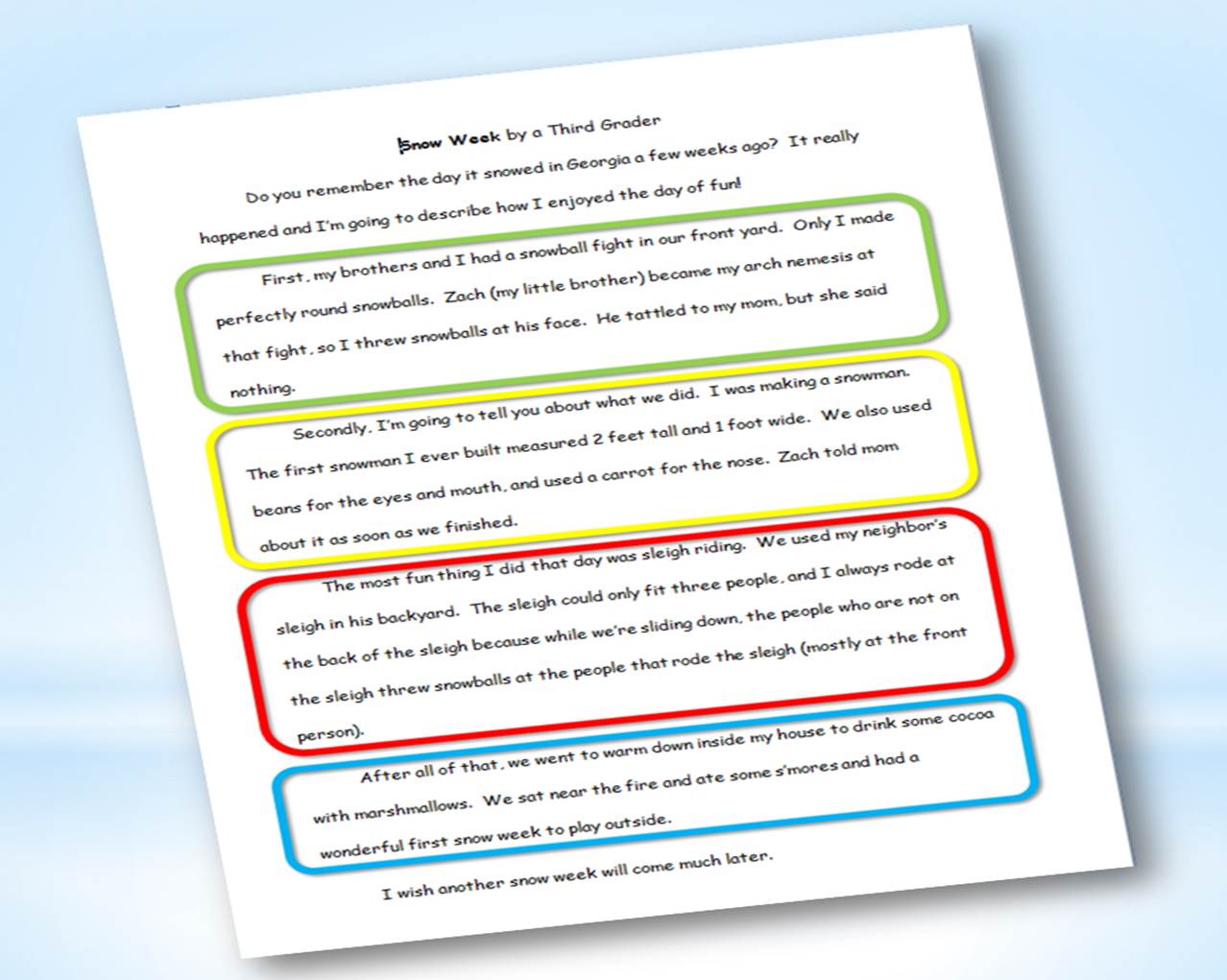
The colored borders were added to the final essay to show which essay paragraphs match up with the encircled mind web ideas(click on the picture to enlarge it).
Why does as mind web organizer work?
- With a single idea centering the web, the student is forced to write about one idea only.
- With two, three, or four subtopics (never more than four or the essay becomes more a laundry list than developed thoughts), the student is forced to break down the topic into a few explaining ideas (expository essays) or reasons (persuasive essays).
- The looseness and scribble-like quality of the mind web relax the student into thinking, “I can do this.” Students turn the paper sideways when they run out of room, or draw arrows to indicate information on the back, or tape another paper to the side and extend the web to a second page. The mind web expands endlessly, encouraging the student to add more details.
- Because the structure is loose, students can add more details as they think of them, even after they begin their first drafts. Change is always possible with a mind web.
The result is a detailed prewriting organizer about a single topic. Sometimes it looks a mess, but the only ones who need to read it are the students and I. When parents first see the mind webs of their children, shock crosses their faces, but later, when I show them the writing that the mind webs lead to, their surprise turns into smiles.
Mind webs are easy and they work for expository and persuasive essays, two of the main kinds that students need to write. But what kind of organizer works for narratives? We’ll talk about that in the next blog.