Use dialog to begin sentences and paragraphs in order to add variety and life to writing

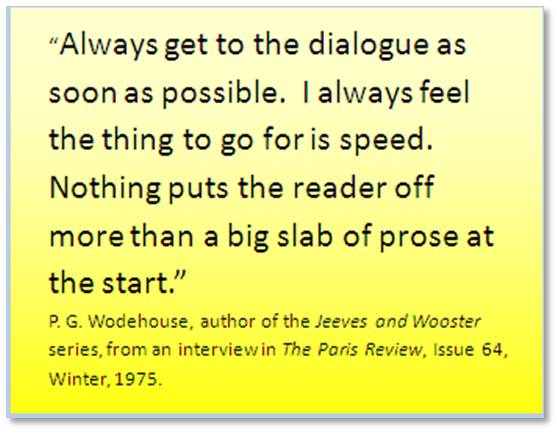
Author's Quote on adding dialogueHave you ever turned the page of a novel and come to long paragraphs of description or exposition?  And then the corner of your eye sees far down the next page a section of dialog?  What do you do?  Do you read the long paragraphs or do you jump to the dialog with its short sentences and friendly white space?

If you are like most people, you beeline to the dialog.

Dialog makes writing sparkle.  Once I read a novel in which there was no dialog, none whatsoever.  Over and over I wanted to quit.  This novel taught me the power of dialog in writing.

Children read chapter books like Junie B. Jones that are full of dialog, but children rarely think of adding dialog themselves.  However, once they add dialog they keep adding it, and their writing improves tremendously.

Why?  One of the easiest ways to get personality into writing is to introduce a character—even if it is the writer herself—whose unique way of thinking and saying attracts readers.  Charles Dickens was a master of this.  But so are some of my students.

dialog example

Notice how a third grade student uses dialog to show his personality and to hook the reader.

Adding dialog is like adding powerful verbs.  It has the same effect.

Sometimes when I read a student’s writing, I suggest, “This would be a good place for dialog.”  Often the student has people talking anyway, but using indirect speech.  I show the student how to turn the speech into direct quotes, and how to start a new paragraph when a different person speaks.

Dialog can also be a great hook in the introduction of an essay, providing that the person speaking says something worth hearing.

One caveat:  Sometimes, once students learn the power of dialog, they want to write only dialog, leaving out any sense of setting or nonverbal action.  In these cases the writing is confusing.  Help the student to see that some description of place, time and the emotional reactions of the people talking and listening are important for a well-rounded essay.

Next we’ll look at sentence types and how they impact writing.

Parts of speech used at sentence beginnings should vary

For older students (usually fifth grade, but sometimes third or fourth grade for better skilled students), I analyze the parts of speech of first words of sentences.  If the student doesn’t understand nouns, pronouns, etc., there is no point in doing this, but if the student does or should understand parts of speech, this can be a useful way to explain why his repetitive patterns seem boring to readers.

A way to Analyze what parts of speech are being used to begin sentences.

Out of 20 sentences in a student’s essay, the sentence openers were frequently adverbs and articles, but verbs, subordinate conjunctions, gerunds and infinitives were not used at all. Knowing this, a student can improve his writing style by including the other parts of speech as sentence openings.

After the student has circled the first word of each sentence, I ask her to tally the parts of speech she has used for each first word of a sentence.  These parts of speech include nouns, pronouns, articles, adjectives, verbs, adverbs, prepositional phrases, conjunctions, gerunds and infinitives.

Students usually notice that they rely on the same parts of speech to open sentences.  Meanwhile, other parts of speech are rarely used.

Next, we go back over the essay and look at the overused parts of speech and try to vary the openings by using underused parts of speech.

  • Prepositional phrases are sometimes used by students only later in sentences. If the phrases are adverbial, they can be moved almost anywhere in the sentence, including to the front.  The student encircles the phrase and draws an arrow to move it to the front of the sentence.
  • Adverbs are often overused as first words, especially the words “also” and “then.” Most of the time these words can be eliminated without any loss of meaning.  But sometimes a synonym can replace those words so long as it does not draw attention to itself.  “And” is usually less conspicuous than “additionally.”
  • Verbs are rarely used as sentence openers because to start a sentence with a verb is to ask a question. Yet a rhetorical question not only varies the sentence opening, it varies the sentence type from a declarative to an interrogative.  Plus, like using a semicolon, it can seem elegant.
  • Most underused are gerunds and infinitives. Younger children rarely think of these words as sentence openers.  Modeling how to change sentences using these parts of speech can be an eye-opener for students who want their writing to sparkle.
  • Many students use complex sentences, but few put the subordinate clause first. Doing so adds a subordinate conjunction to the front of a sentence and changes the sentence structure.

Another kind of sentence opening that students don’t use often enough is dialog.  More on that in the next blog.

Sentence beginnings should vary

Here is how many younger children write:

Today I woke up and ate breakfast.  Then I got on the school bus with my friend, Anya.  I sat near the window.  I put my backpack on a hook and I sat down.  I did my morning work first, and then I said the pledge.  I did math until it was time to go to specials. 

Do you notice that almost every sentence begins with “I,” and the two sentences that begin with another word use “I” as the second word?  What is the effect?  Boring.

Yet this is how beginning writers start their sentences.  Their world is “I” focused, and so is their writing.  As they grow older, this tendency wanes, but repeating the same word at the beginnings of many sentences continues.

Revising general wording to more expressive wording.

An excerpt of a third grader’s essay with his revisions.

Here’s how I break students of this habit.  First, I ask the students to circle the first word of every sentence, using a color quite different from the color they used to encircle verbs.  That is so the first words stand out.

Next, the students read the words aloud and listen for repetition.  Almost always they find it.

For new students, I offer suggestions on how to vary sentence openings.  This is a skill older students learn quickly, so after the first few lessons, they can work independently on future writing.  What are some easy yet effective ways to improve sentence openings?

  • Many sentences begin with a pronoun like “he” or “she.” I suggest using the person’s name if it hasn’t been used, or repeating the person’s name.  If it has been used as a sentence opening in a nearby sentence, I suggest using a relationship, such as “My mother” or “My music teacher.”
  • Sometimes there is a prepositional phrase later in the sentence which could easily be moved to the front of the sentence. “I went to school in the morning” could be changed to “In the morning I went to school.”
  • An adverb can often be added to the front of a sentence unless this technique is overused by the student. I help students find a less common adverb, such as “later” rather than “next” or “then.”
  • Sometimes consecutive sentences can be combined to eliminate a repetitive opening word. “I did my morning work first, and then I said the pledge.  I did math until it was time to go to specials” can be replaced with “I did my morning work, said the pledge, did math and then went to specials.”
  • Sometimes writing a new sentence beginning is what works best.

Next we will talk about changing parts of speech at the beginnings of sentences.

How to replace is, are, am, was, were, be, been and to be.

The hardest skill students learn is how to replace the verb “to be.”  Yet is it the single most important skill for improving the verbs in their writing.

The problem is that the verb “to be” rarely has strong synonyms.
As a linking verb it can sometimes be replaced with another linking verb.  “He is sick” can become “He looks sick” or “He feels sick” or “He seems sick.”  But none of those replacements is much stronger than the original verb, “is.”

Change common verbs to more expressive verbs.

An excerpt of a third grader’s revised essay.

Even harder is when the verb identifies something that exists.  How do you restate, “That dog is mine.”  “That dog was mine,” changes just the verb tense; it is the same verb.  “That dog becomes mine,” changes the meaning.

What I tell my students is that usually they will need to replace not just the verb, but the whole sentence.  I ask them to tell me what the sentence means, using other words.  For the sentence, “He is sick,” I ask how they know he is sick.  What does he look like that would let me know he is sick?  They might say, “His face is red and he has a fever.”  I might say, “That’s good, but you are still using the word is.  How can you tell me that his face is red and that he has a fever without using the word ‘is’”?  Usually they are stumped, so I offer suggestions.  “His mother placed an ice bag on his flushed forehead.”  Or, “’Wow!  101 degrees,’ said his mother shaking the thermometer.”   Or, “The feverish boy lay down on the cold tile floor, moving every few seconds to chill his hot body.”

The trick is to let the reader see, hear, touch, smell or taste (usually see) what the writer saw in his mind before he wrote, “He is sick.”  “He is sick” is a conclusion based on certain facts.  What are the facts that led the writer to conclude that “He is sick”? Those facts are what the reader needs to know so that the reader can come to his own conclusion that “He is sick.”

We’ll have more blogs on changing the verb “to be” in the future because it is such a vital part of improving writing, yet such a difficult skill to master.  For now, we’ll move on to the next blog about sentence beginnings.

How to replace weak verbs with strong ones

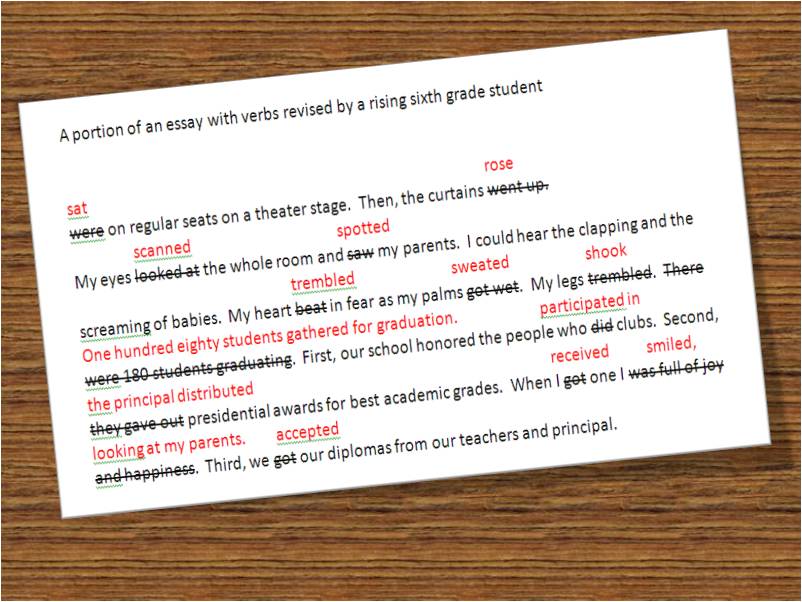
Excerpt from a student's paper showing revised verbs.

Click on the picture for an enlarged version.

Replacing weak verbs with strong, specific ones is the key to good writing.  When new writing students begin with me, I work one-on-one with the students on this skill over and over to be sure they understand its significance and how to do it.

First, the student identifies the verbs used in the piece of writing, and lists them with tally marks to show how often the student used them.  To revise, we start with some easy words to replace, such as get, go, do, make and take.  The verbs are already encircled with color in the essay, so it is easy to find one of those words.  The student reads the sentence aloud, and I ask if he can think of any word to replace the weak verb.

In the sentence, “I go to JFK Elementary School,” for example, the student ponders the word “go.”  “I take classes in,” he might suggest.  With more prodding he might say, “I study in.”  I might accept that in a third grader, or I might suggest the word “attend” for an older student.  He crosses out the word “go,” and writes “study” or “attend” in the space above the crossed out word.  Then we move on to the next word.

In every revising lesson, I ask the students to use a thesaurus.  Many students have not used a thesaurus (or dictionary) before (except online), so this becomes a mini lesson on how to use those resources.  For the sentence, “I gave the dog a bath,” the student needs to know that a verb is always listed in the present tense, so the word to look up is give, not gave.  I explain that because “give” is so general, there are many meanings listed.  The student cannot pick any one.  He needs to choose a meaning that works for the sentence.  Sometimes we discuss which word works best based on many factors such as the child’s age, his grasp of vocabulary and the degree of formality of the writing.

Rarely does the student replace every weak verb.  Since I am teaching the student a process, nailing each verb is not my goal.  Learning that weak verbs should be replaced, and knowing how to replace them, is.

The hardest verb to replace is the verb “to be.”  We will talk about that in the next blog.