
Suppose a talented but easily bored third grader needs to stay focused on her writing lessons in order to improve her writing skills. This student likes silliness, absurdity and humor in writing. (Don’t we all?) My solution: Take short passages from books, replace dull parts, and add humorous details.
My student and I began with a passage from the novel Wonder. In the passage, a mother is in the hospital, about to give birth, when the nurse helping her farts — not not a sneaky fart, but a loud, explosive fart. (Kids love to read about farts.) Meanwhile the doctor faints and the angry father doesn’t know what to do.
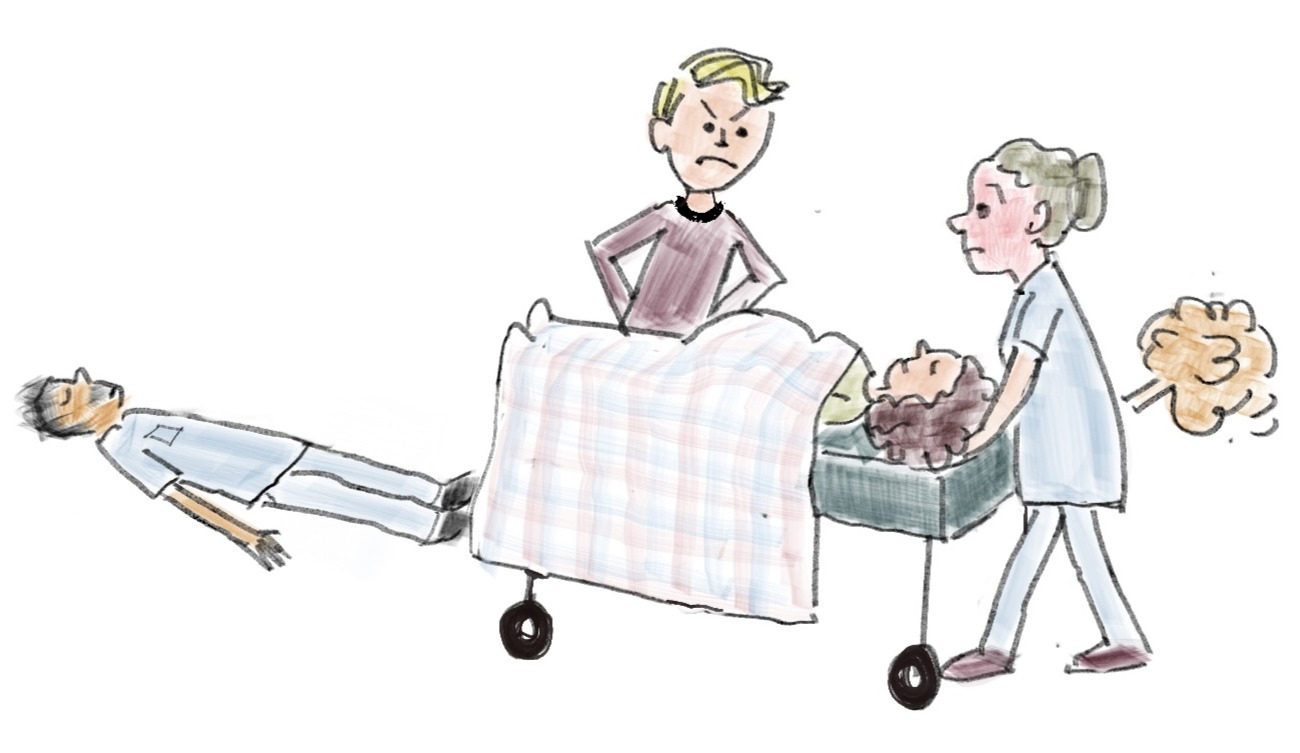 I suggested to my student that she imagine what comes next in this situation and write about that. I had to convince her that because this was writing practice, she could write whatever she wanted. It didn’t have to agree with the book or even be true. She was not convinced. So I took the lead and wrote the next sentence.
“Hey! I’m having a baby over here!” the mother said. “Somebody help me.”
My student’s eyes lit. She quickly wrote the next sentence:
“But I am tired. Let’s wait for the doctor to wake up,” the farting nurse said.
My turn. I wrote:
“The baby’s coming NOW!” the mother cried.
My student wrote next:
“What kind of hospital is this? Our baby needs to be born,” the father shouted.
And so we continued until the end of class, or should I say past the end of class because the student wanted to continue.
Is the writing outstanding? Well, for a third grader, it’s pretty good. Was the student engaged? Definitely. Will the student use dialog in the future? Probably, especially if we practice it more.
Did it make a difference that the teacher was writing? That might have been the most important factor of all. It’s always more fun if you work with someone else. In this case, the teacher was more of a fellow writer than an expert, so the student was not intimidated. I deleted parts of what I wrote and rewrote them, modeling good writing practices. I responded to my student’s ideas, letting her know her ideas were important.
Is this a practical writing exercise? Yes, most teachers can do this with a class weekly or biweekly. The problem is finding a writing passage to launch the student/teacher collaboration. Some possibilities are
- Mark Twain’s work. It’s all in the public domain now, so you don’t have to worry about copyrights. And it’s full of humorous scenes and dialog. Tom Sawyer convincing his friends to paint the fence. Tom falling in love with Becky. Tom and Huck showing up for their own funerals. Huck dressing like a girl to visit a river town. If a passage is too long, it only takes a few minutes to paraphrase it and send it to students’ networked computers.
- Scenes from Judy Bloom’s Fudge. You’d have to summarize a scene like the father pouring the meal over Fudge’s head in the bathtub, but most kids are familiar with Fudge’s antics anyway. The idea is to write them in your own style, with your own imaginary details. Two or three kids could collaborate and later share their passages after the teacher patterns how to work together.
- Wimpy Kid Greg finds himself in dozens of silly predicaments. Look at the pictures and write what you see, forgetting Jeff Kinny’s words on the page. Elaborate on what students know by adding new details.
- For older students, take Romeo’s words about Juliet being the sun to a jealous moon. What would Juliet say if she were a female Young Sheldon who didn’t get poetry or metaphors? Or rewrite Mercutio’s double entendres as a conversation with his friends.
Teachers might say, I don’t have time for this. But do you have an hour once a month to create or find a passage to use with your class? Could other teachers do the same and share their work? Students need imaginative writing lessons to improve their writing skills.


 English Writing Teacher