Category Archives: Including details in writing

Adding numbers enhances student writing

When I help students revise essays, we are always adding details. On their own, children rarely add enough details to their writing. They think that being general is adequate (“We flew up north” as opposed to “Mom, Dad, Lily and I flew to New York”). Sometimes the student is lazy and wants to get the writing done quickly. Sometimes the student is unwilling to hold a pencil and writes the shortest sentences possible. Sometimes the student is in a hurry to play with friends or to watch video games.  Students need to be taught that adding details is important because it makes writing far more interesting.

One kind of detail that is usually easy to add is numbers. But a  common problem with using numbers is that the child may not be sure of the exact number, so he says “some” or “a few” or “lots of.” Children want to be honest, and they think saying “twelve” students attended the party when maybe only “ten” did is dishonest. They need to be taught that it is more important to use an estimated number than it is to be absolutely accurate in student writing.

Here is a fourth grader’s description of a woven basket containing coasters. Notice how the numbers he uses add truth to the essay.

This short artistic cylinder is made from five rows connected by knots. The lid has a woven spiral with holes in between. It is 4 ½ inches tall with a diameter of 5 ½ inches. The circumference is 16.5 inches and the depth is 3.5 inches. The interesting lid is a woven spiral with five small, tan and orange shells in the middle. On the bottom of each smooth shell two rows of tiny rough teeth show. The teeth are also shiny, and the shape of the shell resembles a football.

Here is a sixth grader’s introduction to an essay about starting middle school. Notice the variety of ways this student uses numbers: to describe grades, to name a date, and to count buses, teachers and classmates.

Daniel and I have passed fifth grade and now we are starting sixth grade at Duluth Middle School which opened on August tenth, 2015, welcoming three loads of buses on a mild summer morning. On the first day I greeted my five teachers and hundreds of classmates and learned about my schedule.

Here is a first grader’s description of how to play hopscotch. She uses numbers to describe the hopscotch board.

You need chalk, pebbles, a driveway, and one kid or more for hopscotch. First, you draw a board with chalk on the driveway. It has ten boxes. The first box is a square by itself. It has the number 1 in the box. Next, the 2 and the 3 squares are right beside each other like partners. You keep repeating the boxes but the numbers go from 1 to 10. One kid goes first and throws the pebble anywhere on the hopscotch board. Then, the first player hops on one foot on the 1. And then the player hops on the 2 and the 3 at the same time. Then the player keeps going. But do not forget to pick up the pebble. When the player reaches 10 the player gets off the 10 and goes to the back of the line. Nobody wins but everybody has fun.

And lastly, here is the introduction to an essay in which a fifth grader describes himself. His bravura writing style attracts the reader, but notice how he uses numbers to enhance that style.

In 34 more days, I, Robert Sir Awesome the Third, am going to turn eleven. Bha ha ha! I will tell you about the life of a boy in the twenty-first century, or shall I say, about my life, including my sister, being the oldest child and school.

Don’t you agree that numbers increase reader interest in these student writings?
Use the cube to add detail to children’s writing

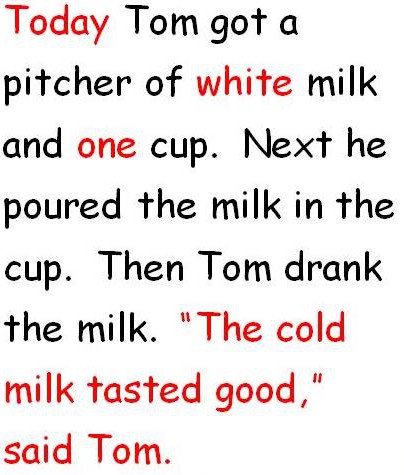
Today I worked with an eager kindergartener on writing a short paragraph. She wrote three sentences describing a sequence of events (a child standing at a table with a pitcher of milk and an empty glass, the child pouring the milk into the glass, and the child drinking the milk). Then I introduced the cube to her.

paragraph showing kindergartener's writing with details addedI had created a cube from a tissue box covered with paper. On the faces of the box I had pasted reminder words for kinds of details to add to writing. The words and phrases were “proper nouns,” “numbers,” “date, day, time, season,” “examples,” “direct quotes” and “sights, sounds, tastes, smells.”

After my student finished her paragraph, we tossed the cube. “Numbers” turned up on top. We looked for a place in her writing where she could add a number. She took out the word “a” and replaced it with the number “one.” This change was insignificant but easy for her to accomplish.

We tossed the cube again. This time “dates, days, time of day, seasons” came up. I explained what the words meant, and immediately she said, “Today.” Without my help she found a place to add “Today,” making it the first word of her paragraph.

detail suggestion cubeNext, “sights, sounds, tastes, smells” came up. We talked about the word, “milk.” I asked her if milk has a smell. “Not really,” she said. “How about a color?” “White,” she said. We found several places to put “white,” and she picked the easiest.

For the fourth and last toss of the cube, “direct quote” turned up. We had previously talked about adding how the boy felt about the milk, but she had balked at writing another sentence. However, when the cube directed her to add a direct quote, she added another sentence to the end of her writing.

This was my first time using the cube to encourage a student to add detail. It worked because the child found the cube fun to use. My experience in tutoring children to read and write is that the younger the child, the more games or gimmicks need to be incorporated into the work. Also, lessons need to be short and end before enthusiasm wanes. That is why we stopped after four throws of the cube. She was still engaged, and we needed to move on to the phonics part of her lesson.

Writing summaries of nonfiction

By middle school, today’s students are required to write summaries even though a generation ago this kind of writing began in high school. The Common Core promotes this kind of writing, as does students’ need to be able to write research papers at younger ages than in the past.

Summaries are written for many reasons:

  • Notetaking (listening to a lecture and discerning the important parts, or reading research and paraphrasing the important parts),
  • Understanding a reading passage (rewriting the main ideas to better understand them), and
  • Identifying the main points (turning an outline into a paragraph or two, or gathering information to use for later studying).

Students encounter two problems over and over when writing summaries:

  • How long should a summary be?
  • How much detail should be included in a summary?

Unfortunately, there are no clear-cut answers to either question, but here’s what I tell my middle grade students about summarizing nonfiction reading selections:

  • First, read the whole reading selection so you know what it is about and so you can judge what is important and what is not. If you don’t understand the selection, this is the time to ask questions.
  • If a reading selection has eight paragraphs, then (for middle grade students) its summary should have about eight sentences. Summaries are concise versions of the original, with major ideas included and most supporting details eliminated.
  • However, if the first paragraph or paragraphs are there only to hook the reader, then their ideas should not be included in the summary.
  • If a paragraph is a single sentence, perhaps it can be combined with another sentence in the summary. Or perhaps it is not important.
  • If a paragraph is more than five sentences, or if it contains a series of important ideas, then more than one sentence should be written to summarize it.
  • At the beginning, even before the topic sentence, the student should name the piece of writing being summarized and its author, and any particular ideas that would be helpful to the reader. The student writer should let the reader know that he is reading a summary. Sometimes this information can be included with the topic sentence.
  • Even though a summary is not an essay, a topic sentence is essential to help the reader to understand the summary.
  • A conclusion is sometimes not necessary if it would summarize the summary.
  • A good summary should be complete; that is, it should include all the important information in the original. If an author spends five paragraphs on subtopic A but only one paragraph on subtopic B, then the summary should include more information about subtopic A (about five times more) than subtopic B.
  • If the original text shows a point of view on a topic, that point of view should be replicated in the summary (letting the reader know that the point of view is that of the original author).
  • If the original text is factual and objective, so should be the summary.
  • The student writing the summary should not include his own perspective on the topic. Sometimes this happens unconsciously, for example, by using the word “only.”

How to write a summary or a nonfiction reading selection:

  • When I am teaching summaries to a student, I ask the student to write the main idea of each paragraph being read in the margin next to that paragraph or on a post-it note pasted next to the paragraph.  If the reading selection contains chapters, then I ask the student to write the main ideas of the chapter at the beginning of that chapter.
  • After each paragraph’s (or chapter’s) main idea is identified, the student needs to read all those margin notes and ask himself how they relate to the whole. Why did the author include each of those ideas in his passage? From that musing by the student often comes the topic sentence of the summary. That sentence is the most important one, from which all the others flow.
  • Information in a summary should be paraphrased. Occasionally, quotation marks can show the original words of the author being summarized, but direct quotes should be the exception, not the rule.
  • Summaries are usually written in the present tense.
  • If the summary is more than five sentences, remind the reader that this is a summary by using words like, “as author so-and-so says,” or “as article such-and-such relates.” If the summary is several paragraphs, a reminder to the reader that he is reading a summary should be included in each paragraph.