Monthly Archives: December 2019

Bloated words mean longer, boring writing

Utilize.  Three syllables.  Use.  One syllable.  Why not use “use”?

Price point.  Two words.  Price.  One word.  Why not use “price”?

Vaporous.  Three syllables.  Vapid.  Two syllables. Why not use “vapid”?

Inflating your writing with multi-syllabic or multi-phrasal words when simpler words work just as well makes your writing pompous, long and hard to understand.

So why do it?

  • To sound important. In college I worked as a telephone operator, but my brother suggested I introduce myself as “an international communications coordinator.”  Nobody knew what I was talking about, and when I explained I was a phone operator, they rolled their eyes.
  • To sound educated. Many SAT words are multi-syllablic:  capricious, ephemeral, and facilitated, for example.  But isn’t it easier to understand synonyms such as flighty, short-lived and made easy?  And why do we write?  To sound educated or to be understood?
  • To please an English teacher who confuses big words with deep thinking. In fact, big words obfuscate logic (clutter your meaning) and enshroud cogitation (hide poor thinking).

What can you do to rid your writing of clutter?

  • Look for empty words. If you look, you will find.  Many empty nouns end in “tion,” “ment” and “city.”  Turn them into verbs and then search for simpler synonyms.
  • Tell yourself that big words aren’t better.  They are just bigger.
  • Look up synonyms for long words. Many English words with the most punch are ancient Anglo-Saxon words of one or two syllables.
  • Read the poetry of Robert Frost. Frost rarely used even two-syllable words, and that is no fluke.  He said good writing should be understood on a literal level the first time it is read.

Write short.

Draw pictures to remember what you read

Drawing pictures is almost twice as powerful a memory tool as is reading or writing, according to the George Lucas Educational Foundation called Edutopia*.

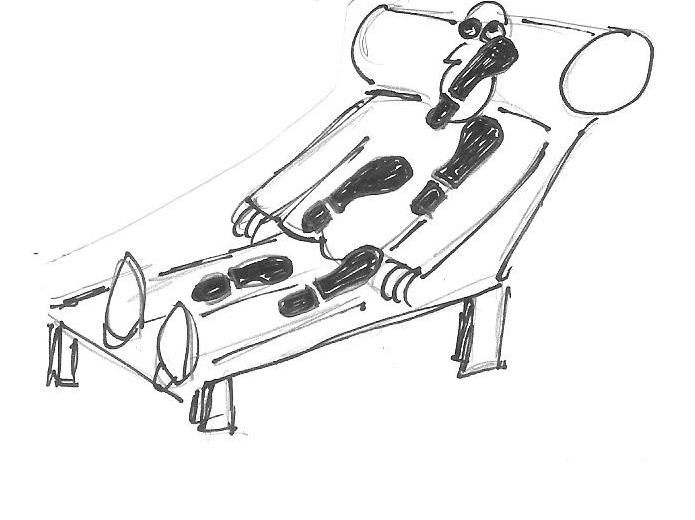
Cartoon of a man with footprints up his body and the words, Unassertive: wimpy

Mutilate

When you draw, your kinesthetic , visual and linguistic brain centers all work.  Your brain processes the information you draw in ways which “interact,” forming strong bonds and deeper memory.

How to take advantage of drawing to improve memory:

One way is to draw when you take notes and write rough drafts. You can do this no matter how good or how poor an artist you are.  In a science class, for example, to show the water cycle, draw the sun with water below and arrows from the water heading up toward the sun.  Write “evaporation” next to that image.  Next to it draw clouds in the sky with rain drops falling out of them.  Next to it write “condensation.

Cartoon of a man with footprints up his body and the words, Unassertive: wimpy

Unassertive

Another way is to use mind webs (sometimes called spider webs or concept maps) to show how concepts are connected.  For example, draw and label the topic in the center, and then draw spokes out from there.  At the end of each spoke, draw another picture and label it with simple annotations.

Use interactive notebooks, that is spiral or composition notebooks in which you take notes with pictures which your draw yourself or which you cut out and paste. You can draw or paste timelines. You can paste vocabulary cards which you can flip to see definitions or pictures of definitions.  You can draw or paste political cartoons on the subject you are studying.

Cartoon of a waterskiier withe the caption, Aquatic: relating to water

Aquatic

Use visuals to show data—timelines, sequence ovals with arrows, graphs, and maps.

*For more information and a cleverly illustrated version of the above ideas, go online to Edutopia News.

Maybe the textbook writer is to blame, not the student

Not all textbook writers are good writers.  They might know their subject, but they might not know how to write.

I learned this as a college freshman when I was assigned to read a nonfiction book by an expert in his field.  I read the first page and realized I didn’t have any idea what I had just read.  So I reread it.  Nothing.  I read the page a third time and a fourth.  And then I stopped.

I was a good student.  The author was an expert.  What was going on?

I counted the words in the sentences.  Every single sentence had more than 50 words!

I analyzed the sentences.  They were all complex sentences with three or four or even five dependent clauses.  That meant that each sentence had at least four ideas of varying importance which I was required to juggle before I reached the period.

And every sentence had great big words—SAT kind of words.

Ph. D. or no Ph. D., that expert couldn’t write.

And so I began the time-consuming task of translating academic English into plain English which I could understand.  Clause by clause, sentence by sentence, and paragraph by paragraph, I rewrote the first chapter of my text.  What a pain.

From this experience, I came to believe that coherence—the ability of ideas to be understood—is the most important criteria to judge writing by.  If ideas are not logical, if they cannot be understood, then they are useless.

If you are a good student and you are reading an impossible text, analyze it for its readability.  Chances are, the problem is the book and not you.