Yearly Archives: 2016

Use a thesaurus to write better

A thesaurus is a book or online source for finding synonyms and antonyms of words.  Here is how a thesaurus can improve your writing.

  • A thesaurus can suggest a variety of words to replace a generic or overused word. For example, the word “ran” can mean “raced,” “rushed” and “hurried.”
  • A thesaurus can offer a more precise word to replace a general word. For example, “ran” can mean “sprinted,” “loped” or “leaped.”
  • A thesaurus can offer nuances for words which have shades of meaning. For example, “to run” a business can mean “to regulate,” “to manage” or to “carry on.”
  • A thesaurus can jump start your brain with words you might not have considered. For example, “to run into debt” can mean “to incur” or “to acquire” debt.

But using a thesaurus can lead to problems.

  • Since not all synonyms for the same word are synonyms for each other, you must be sure of the meaning of a suggested word before you use it. Using a dictionary to find the precise meaning of a thesaurus-suggested word is a way to avoid this problem.
  • Some synonyms can sound pretentious when you want to write simply, or some synonyms can sound casual or even childlike when you want to write seriously. If you are writing fiction, a long word in the mouth of a child can sound ridiculous.  So can a slang word in the mouth of a courtroom attorney.
  • Some synonyms can sound unnatural for you, the writer. For example, I tend to write using short words of Anglo-Saxon origin, so long Latinate words sound wrong for my writing style.  Sometimes I look up a synonym and decide that the simple word I started out with is the best choice.

One more word on thesauruses.  (Or is it thesauri?)  Different kinds exist, ranging from a children’s thesaurus with pictures and limited words (meant for a beginning reader and writer) to an adult thesaurus (meant for fourth or fifth graders and older).

For serious writers, I recommend the Roget’s International Thesaurus.  This thesaurus is a two-part version, requiring you to look up a word (such as run) and then decide on the general meaning you are seeking.  When you find that meaning, you go to a different part of the book for a more detailed list of synonyms.  Compared to a one-step thesaurus, the results of this two-step thesaurus—precision, nuances and sheer number of synonyms—are superior but more time-consuming.
I want my kids to write more this summer. Any ideas?

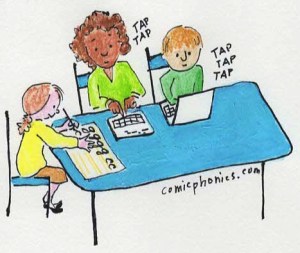
Yes.  First, I would let the children know that they will be writing every day this summer.  Give them time to get used to this idea.  And tell them you will be writing too.  Every assignment they do, you will do too.  Your commitment shows them how important you think writing is.

EPSON MFP image

Set up a schedule for writing time and stick to it.  Some kids think summer should be a completely unscheduled time.  Dispel this myth.  Let them know that at a certain hour every day they and you will write.

If the children have a computer or tablet available, let them use it.  This will make the idea of writing daily more palatable.  (But check to be sure they are writing and not surfing or gaming.)  Research shows writers write better when they use electronic equipment, perhaps because of the ease of erasing, moving around phrases and looking up synonyms and spelling.  If you have only one such device, stagger the writing times.

Since finding a topic to write about day after day will be a problem for your children, you decide on topics ahead of time.  You know your children’s interests and experiences.  You know what they have studied in school, what hobbies they enjoy, what trips they have taken.  These are excellent topics for writing.

Insist the children create some kind of prewriting organizer for each writing assignment.  Insist too that it be detailed.  Let the children know you want to see the organizers before they begin their first drafts, and that you will show them yours.  Monday’s writing assignment could be to develop such an organizer.  Together discuss the problems and benefits of creating an organizer.

Tuesday’s assignment could be writing the first draft.  Since knowing how to begin is often a problem, help your children.  Make suggestions to one another.  Let them help you too.  Let them see you as a learner in the writing process.  Prod the child to begin, even if the beginning isn’t great.  It can be improved later.  Allow errors and mediocrity at this point.  It’s better for the writer to get into a “flow” state of mind and to continue than to stop and start to fix errors.

Wednesday’s assignment could be to write a conclusion and to begin to revise.  If the child has trouble writing a conclusion, suggest possibilities.  Then, read aloud your draft and self-correct as you go along letting the child hear how it is done.  Ask each child to read aloud his or her draft, and let him fix the errors he hears.  Suggest places that are skimpy or confusing.  Insist that the children add more details, such as proper nouns, numbers, dates, sensory information, and for examples.

Thursday’s assignment could be to continue revising.  Identify verbs and strengthen them.  Identify sentence beginnings and vary them.  Identify lengths of sentences and vary them.  Older children could identify types of sentences used and vary them.   Final drafts should be completed and printed by the end of Thursday’s writing time, or if revision takes a long time, have the children prepare their final drafts at the beginning of Friday’s writing time.

Friday’s assignment could be to evaluate each piece of writing.  Use two columns marked “Did well” and “Needs improvement.”  Start with the “Did well” column, listing things the child did well, like sticking to one idea, organizing, adding humor, writing dialog, writing clearly, using capital letters—anything which will give the child confidence.  In the “Needs improvement” column, ask the child what he or she thinks needs improvement.  Maybe limit comments to the two areas the child thinks he needs to improve the most, such as run-on sentences, using direct quotes, spelling it’s and its or remembering to use periods.

On Friday also you could agree on Monday’s topic.  If the kids need to think about it or do research, they can do that over the weekend.  Let the children suggest topics.  The more they control the process, the more willing they will be  to participate.

Lastly, hang up the finished final printed drafts on the refrigerator or someplace where they can be admired.

(If you need information on any of these parts of the process, scroll back through these blogs.  Any blog might make a good mini-lesson.)

Teach children how to think and write like reporters

Reporters are taught to begin news stories with the most important facts first—the who, what, when, where and how.  Less important facts go later in the story.  That way, if the story needs to be cut to fit a space, all the important facts remain.

Writing this way can be a worthwhile exercise for children.  It forces them to use higher level thinking skills:  to analyze a situation and rank facts in a hierarchical order, most important to less important.

news reports JFK's death

A good time to teach this kind of writing is during a social studies class.  Suppose the students have just finished studying the assassination of JFK.  What if they are reporters in Dallas and the assassination has just happened?  How would they write the story?

First, discuss with the students what the important facts are.  Then ask students to consider in what order the facts should be reported.

  • Would the story’s lead sentence start with the time or date? “At 12:30 p.m. central time on Friday, November 22, 1963. . .”
  • Would the sentence start with the place? “At Dealey Plaza in Dallas, Texas. . .”
  • Would the sentence start with the how? “With gunshots. . .”
  • Would the sentence start with who? “President John F. Kennedy. . .”
  • Would the sentence start with what? “An assassination. . .”

In this case, the news story would start with the who since the most important fact is the President of the US.  The next most important fact is that that the President died.  How and where probably rank next.  The least important fact is the date and time it happened.  “President JFK died from gunshot wounds in Dallas, Texas at 12:30 today” might be a good first sentence.

News stories don’t always begin with the who.  Suppose Hurricane Katrina is approaching Louisiana and Mississippi but has not struck yet.

  • Would the lead sentence start with the time or the date: “Sometime tomorrow, Monday, August 29. . .”
  • Would the lead start with the where: “The coast of Louisiana and Mississippi. . .”
  • Would the lead start with the who: “Millions of Americans. . .”
  • Would the lead start with the what: “A category four hurricane. . .”
  • Would the lead start with the how: “With a storm surge expected to surpass 12 feet and winds of more than 130 m.p.h. . . .”

In this case the what and the where are most important, followed by the when.  “A category 4 hurricane is expected to slam the coast of Louisiana and Mississippi in the early hours of Monday” would be a good lead sentence.  How many people could be in harm’s way and the details of what a cat 4 hurricane can do are important, but they are less important than the fact of a strong hurricane threatening a particular area.

Writing like a reporter combines critical thinking skills with writing skills.  If the children report on a breaking news event, they can match their efforts with the stories of real reporters.  Or they can report on real happenings in the classroom–a spelling bee, a field day, a class visitor.  Connecting writing activities to real life events is a sure way to engage students.

Would you read—or discard—a book based on its first paragraph?

I do it all the time.  I figure if a writer hasn’t put enough thought into hooking me, then maybe the writer hasn’t put enough thought into maintaining my interest over 200 or more pages.

These days first paragraphs and first pages of a story need to attract.

Table first paragraphs of books

To prove this to my students, I read to them the first paragraphs of a dozen or so novels, histories and biographies.  I asked the students to record why they would or would not continue reading.  Only after they had written their comments did I tell them the names of the books.

Under “I wouldn’t continue reading” the students wrote

  • No action
  • Boring
  • Not interested in topic
  • I don’t get it

Under “I would continue reading” the students wrote

  • Action, adventure
  • Humor
  • I want to find out more about something

Rejected books include The Great Gatsby, Hatchet, Johnny Tremain, Bridge to Terabithia, Anna Karenina, North to the Orient, Little House in the Big Woods, Stuart Little, Walden, and For Whom the Bell Tolls.

 Books which hooked my fourth through seventh grade students include Superfudge (“I want to know what the big news is.”), John Adams (“I like the description of the winter.  I want to know why those men were out on such a cold day.”), To Kill a Mockingbird (“I want to know why Jem’s arm got broken.”), Ronald Reagan (“It’s funny.  Why does it help to be a dummy?”) and Angela’s Ashes (“Why did Margaret die?”)

Only one book sparked keen interest by every single student, and that was Juliet by Anne Fortier.  Its first paragraph is four words:  “They say I died.”  “Why do they say she died?”  “She must not have died or how could she be telling the story?”  “How did she almost die?”  “I want to know more.”

Juliet is the most recently published book (2010) of all the ones I read, and John Adams and Ronald Reagan, two others which attracted, were published in the past 20 years.  Most of the rejected books were published some time ago.

So what?  I can tell students how important a beginning is—to a story, to an essay, to any kind of writing.  But now they know from their own experience.  Their homework assignment is to write a compelling first paragraph.  Stay tuned.

Universal English spelling is American English spelling

Not sure what English to use on the internet?  Use American English.

When it comes to spelling color / colour or ton / tonne on the internet, American spelling dominates around the world. Research shows that 80% of the English spelling on the internet is American spelling.

In past years, English writing directed at a particular national audience would have deferred to that nation’s preferred way of spelling.  “Recognize” would be used for US audiences and “recognise” for British, Canadian or Australian audiences.

But with the internet reaching audiences on all seven continents—and with more than half of all internet content written in English—tailoring websites or blogs to particular English-speaking groups is no longer practical.  And so, in most cases, American English has become the default English of the internet.