Yearly Archives: 2016

“Never let a fool kiss you, or a kiss fool you.”

Do you like this quote by comedian Joey Adams?  It’s an example of an elegant and clever figure of speech,  the chiasmus (pronounced ki-AZ-mus).  You might not have heard the word, but you have heard other examples, such as

  •  “Let us never negotiate out of fear, but let us never fear to negotiate.” (John F. Kennedy)
  • “Do I love you because you’re beautiful? Or are you beautiful because I love you?” (Oscar Hammerstein)
  • People the world over have always been more impressed by the power of our example than by the example of our power.”
    (Bill Clinton)

A chiasmus (also called inverted parallelism) inverses the original grammatical structure or idea in a sentence using a particular pattern.  First comes an idea or structure in two parts, such as A (Let us never negotiate) and B (out of fear).  Then comes the inversion, starting with part of B (but let us never fear) followed by part of A (to negotiate).

This inversion can be shown in a diagram as
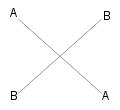
A_B X

A chiasmus can sound formal because its structure is symmetrical.  For example, take JFK’s famous “Ask not what your country can do for you; ask what you can do for your country.”  Its structure can be shown as

A B B A
your country you you your country


But a chiasmus can also sound informal, as by English comedian Chris Addison who said, “The right to bear arms is slightly less ridiculous than the right to arm bears.”

A B B A
bear arms arm bears


Using chiasmi in literature goes back thousands of years when it was popular in Greek writing and in the Bible to underscore order.  Socrates wrote, “Bad men live that they may eat and drink, whereas good men eat and drink that they may live.”  Shakespeare often used chiasmi, such as “Fair is foul and foul is fair” in Macbeth.

Plots can use chiasmi.  At the start of A Tale of Two Cities, Charles Dickens has Dr. Manette curse all the members of the Darnay family; later Manette’s son-in-law, Charles Darnay, is sentenced to the guillotine because of Dr. Manette’s curse.

Chiasmi tend to slow down writing because the reader wants time to understand the logic, and then to marvel at its cleverness.  Used appropriately, chiasmi can add style to your writing.

Six rules for clear thinking and writing by George Orwell

One excellent yet pithy set of rules for writing well comes from 70 years ago by the British writer, George Orwell, author of 1984 and Animal Farm as well as numerous essays.  The rules are part of an essay called “Politics and the English Language” in which he argues that poorly written English results from bad habits of thought.  Get rid of the bad habits and clearer thinking emerges in the mind of the writer and on paper.

His six rules are

  • “Never use a metaphor, simile or other figure of speech which you are used to seeing in print.
  • “Never use a long word where a short one will do.
  • “If it is possible to cut a word out, always cut it out.
  • “Never use the passive where you can use the active.
  • “Never use a foreign phrase, a scientific word or a jargon word if you can think of an everyday English equivalent.
  • “Break any of these rules sooner than say anything outright barbarous.”

Four kinds of words, some good, some not so good

Words can be divided into four kinds, according to a popular business writing blogger.*   Let me paraphrase his four kinds of words:

  • Common words, or everyday words that you can expect your reading audience to know without explanation.
  • Jargon, or words specific to the field you are writing about.  If you are writing about math, for example, you might use “function” and “algorithm,” and expect your audience to understand.  But for new or unusual math words, or for children, you would offer definitions.
  • 50-cent words, usually with many syllables or from another language.  These words are intended to impress people or to act as shibboleths showing that the writer is an insider.  Such words could include “esprit de corps,” “modicum,” and “Neolithic.”
  • Unusual words which hook or delight a reader.  Such words might include “pique” and “hardscrabble,” or for a young child, “triceratops” or “tyrannosaurus.”

How often should you or your students use each type of word?  According to the business blogger,

  • Common words—90 percent of the time
  • Jargon—as needed for your topic, but be sure to define new or rarely heard words
  • 50-cent words—never
  • Unusual words—just a little bit

When teaching writing to children, I find that they stick to the commonest of common words unless they are prodded to try new words..  To expand their vocabularies, I suggest what to them seem like 50-cent words.  If they have heard a word before, they might try it out, but if they haven’t heard it, they prefer to stick to comfortable, overused words.

Children who come from enriched backgrounds have large common word vocabularies.  Children from impoverished backgrounds have small common word vocabularies.  What can seem like a common word to one kindergartener can bewilder another.  It’s important for children’s writing to sound like their own writing, not their teacher’s, so their backgrounds need to be considered if you attempt to stretch their vocabularies with new words.

However, when writing about a particular topic, children need to use the precise vocabulary of that topic.  Words like “pollution” and “predator” should be expected when talking about the environment. Even though these words might seem strange at first, their precision is what makes them useful.  Children need to use the correct names of concepts.

As for unusual words, I encourage children to use one or two to add sparkle to their writing.  Often their “unusual” is my “ordinary,” but if using a particular word delights a child, I encourage it.

*http://withoutbullshit.com/blog/sophisticated-writing-simple-words

A writing problem even Supreme Court justices disagree on

“You tell your scouts to find a defensive catcher, a quick-footed shortstop, or a pitcher from last year’s World Champion Kansas City Royals,” wrote Supreme Justice Sonia Sotomayor in a 2016 court decision.  The problem is, does “from last year’s World Champion Kansas City Royals” apply only to the pitcher, or do the catcher and shortstop need to come from that team as well?

I’ll get to the answer in a minute.  But the real problem is a grammar one.  Should a series of ideas followed by a limiting prepositional phrase or other modifier have that phrase apply to all the items in the series or to the last item only?

Here’s another example, this one from Supreme Court Justice Elena Kagan.  “Imagine a friend told you that she hoped to meet ‘an actor, director, or producer involved with the new Star Wars movie.’”  Do the actor, director and producer all need to be involved with the Star Wars movie or just the producer?

The Supreme Court needed to consider this grammar problem during this past term when deciding Lockhart v. U.S.  The text of a law important to the case’s outcome stated that people convicted of a previous crime for “aggravated sexual abuse, sexual abuse, or abusive sexual conduct involving a minor or ward” needed to serve a mandatory 10-year sentence if convicted again.  But did “involving a minor or ward” apply to the whole series of crimes or only to the third one?

In the court decision, Justice Sotomayor’s opinion won:  the limiting prepositional phrase applied only to the last item in the series.  But a good case (no pun intended) can be made that all three items in the series are covered by the prepositional phrase.

Attorneys need to write laws clearly and precisely so that future attorneys and judges know exactly what the law means.  But the rest of us need to write clearly too.  How could the examples given above have been written to eliminate wiggle room?

  • You tell your scouts to find a defensive catcher or a quick-footed shortstop, or you tell them to find a pitcher from last years’ World Champion Kansas City Royals.
  • You tell your scouts that from last year’s World Champion Kansas City Royals they are to find a defensive catcher, a quick-footed shortstop, or a pitcher.
  • Imagine a friend told you that she hoped to meet an actor, director, or producer, and she hoped the producer was involved with the new Star Wars movie.
  • Imagine a friend told you that she hoped to meet an actor, director, or producer, any one of whom was involved with the new Star Wars movie.

For more on writing clear legal language, see an article in the July 9-10 issue of The Wall Street Journal on page A9.  “How to Write Like Antonin Scalia” discusses other textual considerations as well.

How to gain or lose readers: Use shibboleths

A shibboleth is a word or phrase whose use or pronunciation shows you belong to a certain group or class.  For example, if you sprinkle your writing with OMG, you identify yourself as a texter—perhaps young, perhaps a user of Twitter.  Or if you sprinkle quotes from Shakespeare when you speak, you announce yourself as an English major.

The problem is, not everyone belongs to those groups.  And those who don’t belong can become turned off by your shibboleths just as those who do belong feel drawn to you.

  • Would you know what was going on if a character in a novel says, “Mea culpa, mea culpa, mea maxima culpa” after spilling coffee on a client’s suit? What does that tell you about that character?  (She studied Latin?  She is an older Catholic who remembers those words from the Latin mass?)
  • Or what if you’re reading a mystery and the detective asks himself, “Now what would Philip Marlowe do?”  Would you know who Philip Marlowe is?   (He a fictional character master detective.)
  • If someone pronounces “suite” as “sweet,” what does that tell you? What if he pronounces “suite” as “suit”?  (“Sweet” is a northern US pronunciation; “suit” is a southern and Midwestern pronunciation.)

If you are writing for an audience with similar backgrounds (same culture, same education, same age), you can use shibboleths confidently, knowing your readers will appreciate your clever use of insider terms.  Using shibboleths identifies you as one of them, as someone they can trust.

But if you are writing for an internet audience (various cultures, often English as a second language), you will distance readers who don’t get your insider meanings.  Your readers will feel like people who don’t get the joke.  They may stop reading or continue grudgingly.

Know your audience.  And know your purpose in writing.  Both will inform you about whether you should use shibboleths.