Yearly Archives: 2016

How to use emojis, the lingua franca of the digital world

Written language has always had the drawback of not expressing emotion easily. What can be shown with just a few muscle movements in a face might take a sentence or two to convey in words. What can be conveyed in a millisecond in life can take many seconds in print.
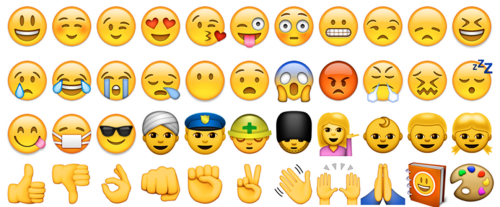
dozens of emojis

Filling this deficiency in words are emojis, pictographs used in digital writing.  They give writers the ability to convey emotion without using a thesaurus to find the specific word; they give young people who rely on broad, nonspecific terms a way to express a more specific meaning quickly and accurately.

If you, like me, are not fluent in emojis, how can you become fluent in this new pictorial way of writing? According to Jonna Stern of the Wall Street Journal, there are three steps.

  • First, familiarize yourself with the emojis which are part of your cell phone. On my iPhone’s text messaging keyboard, at the bottom there is a smiley face. If I click on it, I access pages of emojis. Scroll through the emojis on your phone to become familiar with what ones are there and what they might mean. Not sure? Go to http://www.Emojisaurus.com or ask a fifth grader.
  • Next, realize that using emojis works best for expressing emotions or for giving a quick response (e.g., thumbs up, thumbs down). Try including one or two in your texts, adding to the variety you use the same way you would add new words to your vocabulary.
  • Last, Stern suggests you get a good emoji keyboard. (It’s much like graduating from a children’s dictionary to an adult one.) For the iPhone, she suggests checking out emoji++ or keymoji available at the App Store. For androids, she suggests SwiftKey.

Whether we like emojis or not, they are here to stay. If kids are using them in text messaging, you can be sure they will eventually use them in their writing. But how about in their academic writing? Do emojis have a place in a third grade paragraph on Paul Revere or in a sixth grade pro/con essay on wearing school uniforms?

Maybe not today, but in the future I predict we will see emojis accepted in academic writing. Electronics are changing our world. Why not our writing?

The word of 2015 isn’t a word; it’s a pictograph

An emoji rather than an actual word was named the Oxford Dictionary’s 2015 word of the year.

Not familiar with emojis? According to the Oxford Dictionary, an emoji is “a small digital image or icon used to express an idea or emotion in electronic communication.” (Think of the image of a “smiley face” or a “thumbs up.”) The emoji which won the honor is one showing a face smiling with tears of joy.

emoji smiling face with tears of joy

With so much of our written communication being done digitally or online, perhaps it is fitting that a pictograph should be named English word of the year. An emoji can cross cultures and languages. After all, a smile is a smile in any language.

According to the Oxford Dictionary, the use of emojis is gaining. I thought they were limited to the smiley face and the frowning face, so a face smiling with tears of joy comes as a surprise to me. But so do dozens of emojis I recently discovered on my iPhone. When I key a message, at the bottom of the screen is a small, yellow smiling face. When pressed, it brings up a screen with dozens of emojis, including a face smiling with a tear.

Pictographs are nothing new in writing. Think of the now famous ad campaign for New York: I (symbol of a heart) NY. But they have spread in recent years thanks to electronics. Think of the icons we use. When we want to find something, we touch a magnifying glass. When we want to print, we press the icon of a printer.

Our children are already using emojis, so if we want to monitor their electronic communications, or if we want to become up-to-date with digital communication, we should ecome familiar with emojis: what ones are on our kids’ and our own phones, what emoji keyboards are available for downloading as apps, and how emojis are best used.

Think of emojis as a language in which everyone will be writing soon. If we want to be part of the conversation, we need to become fluent. Where do we begin? More about that in my next blog.

What are the most overused words?

An end-of-year review of the most overused words of 2015 suggested that “so” is the winner.

I have to agree. During the past year I have become aware that “so” is used more and more by someone being interviewed to begin a response.

Interviewer: What does the latest poll show about the candidates?
Interviewee: So, the latest poll. . .

Over time, the way we speak becomes the way we write.  Many of my students begin sentences with “so.” Usually this is when they are thinking about a cause and an effect.

For example, The mother gave the baby a bottle. So the baby stopped crying. So the mother turned off the light. So the baby went to sleep.

Many other words are overused by children learning to write. Among the ones I see the most are

  • “Then.” Children are thinking about a sequence of actions and use “then” to show that one action follows another.
  • “A lot.” Students use “a lot” or “lots” when they too lazy or tired to write a specific amount.  Recommend using a number, even an estimate, as an alternative.
  • “Thing.” (Also “something,” “anything,” and “everything.”)  Ask the student writer to be specific. Using “thing” is a habit of laziness.

The easiest way to correct the overuse of a word is to let the student write the overused word in his rough draft.  When it is time to revise, ask the student to circle the culprit word.   Ask him what he notices.  Usually he will sheepishly respond that he has used a word too many times.  Offer suggestions on how to improve the writing.