Monthly Archives: August 2016

Cursive makes a Southern comeback

As the 2016-17 opens, Alabama joins Florida and North Carolina in mandating by law that students learn cursive writing.Cursive alphabet

Alabama’s teachers must instruct third graders in cursive under a law that goes into effect this school year.  Although Alabama law previously required the teaching of cursive, the new law requires teachers to report students’ proficiency levels to the state at the end of third grade. Formerly, students needed to be proficient by the end of fifth grade.

Implemented in the 2012-13 school year, North Carolina has a law stating that “Public schools [shall] provide instruction in cursive writing, so students create readable documents through legible cursive handwriting by the end of fifth grade.”

Florida implemented its own standard, requiring cursive writing to be taught in third grade in public elementary school classes.

Which cursive will these students use?  Over the years, the type of cursive used by American students has become simplified and for some letters, similar to printing.  For example, the capital Q, which in old cursive looked like a loopy numeral 2, has been changed at the request of the US Postal Service.  The new Q looks more like a printed Q and less like the number 2.  The new capital K, P, R, and T look almost identical to the printed forms of those letters.

With fewer loops, the New American Cursive is quick to write, easier to read, and cleaner in look than the older versions of cursive.  An extreme slant of the letters has been replaced with a slight slant to the right, making the new cursive easier for left-handed students.

For more information on the new cursive, go to www.newamericancursive.com.
How to encourage the addition of more details by students

Sometimes students balk at writing more details when they have finished their first drafts.  They think they have already included plenty of details when more details would enhance the writing.

To encourage the student to write more details, on a separate piece of paper I rewrite one of the student’s sentences needing more details and suggest we go back and forth–first me, then the student–adding details.  Here are some examples.

The student originally writes, “We walked back to the pool.”  I add, “In our flipflops and bathing suits,” to the beginning of that sentence.  “Well, of course we wore our bathing suits,” says my student, so he crosses out “and our bathing suits.”  But he adds, “In our flipflops we walked to the outside pool entrance.

Another sentence the student originally writes is, “My cousin, Johnny, picked up a glass and cut his fingers.”  This time the student starts the additions by adding “soda” to “glass.”  I ask which fingers.  He crosses out “fingers” and adds “thumb and index finger.”  But then without my asking him to, he continues. “My cousin, Johnny, picked up a soda glass and cut his thumb and index fingers.  You could see the fat and blood.  My uncle drove him in a taxi to the hospital emergency room.  My uncle sent a picture to my aunt, showing Johnny doing a pose in his bandage.”  What a difference!

Another sentence my student writes is, “We walked to the gift shop.” Before I could add details, he added “to get rocky road ice cream because it was 100 degrees F.

Why did this exercise work?  By pulling the sentences out of the student’s own work and isolating them, it was easy for the student to see the plainness of the sentences.  By my offering to write some of the additional phrases, the work seemed more like a game, and he was willing to play along.

Were we working on a computer, we could have swiped the new sentences and replaced the plainer ones, making the work even easier.


“Then” is not a conjunction. And usually “then” is not needed.

“Then” is an adverb and cannot be used as a conjunction, even though many of my students think it can.

Wrong:  I went swimming, then I took a shower.

Right:  I went swimming, and then I took a shower.

One way to show that “then” is not a conjunction is to move it around in the sentence.  “I went swimming, I took a shower then.”  “I went swimming, I then took a shower.”  You can see that these would-be compound sentences are actually run-ons even with the word “then” in the sentence.  They need a coordinating conjunction such as “and” or a subordinate conjunction such as “before.”

Many students use “then” as the first word of a sentence to show a time sequence or a transition from one idea to the next.  Students might need to do this as they write down events in chronological order.  But often they overuse the word “then,” with some students starting almost every sentence with that word.  An easy way to deal with this problem is to let the student write “then” all she wants in her first draft.  During revision, have her circle every “then” and cross out all but one. Let her choose which one stays.

Some grammar books indicate that “then” should be followed by a comma when it starts a sentence, or when it interrupts a thought.  A comma indicates a pause in thinking or in speaking, and since we Americans don’t usually pause after the word “then,” it is rarely necessary.

“Then” is one of many overused words by students, along with “so,” “just,” “like” and “and.”  Usually when students are made aware that they are overusing a word, they self-edit, but sometimes it takes several revisions to prove that they overuse certain words.

Also, “then” and “than” are not synonyms.  “Then,” like “when,” indicated time.  “Than” indicated comparisons.


“Never let a fool kiss you, or a kiss fool you.”

Do you like this quote by comedian Joey Adams?  It’s an example of an elegant and clever figure of speech,  the chiasmus (pronounced ki-AZ-mus).  You might not have heard the word, but you have heard other examples, such as

  •  “Let us never negotiate out of fear, but let us never fear to negotiate.” (John F. Kennedy)
  • “Do I love you because you’re beautiful? Or are you beautiful because I love you?” (Oscar Hammerstein)
  • People the world over have always been more impressed by the power of our example than by the example of our power.”
    (Bill Clinton)

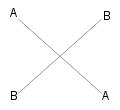
A chiasmus (also called inverted parallelism) inverses the original grammatical structure or idea in a sentence using a particular pattern.  First comes an idea or structure in two parts, such as A (Let us never negotiate) and B (out of fear).  Then comes the inversion, starting with part of B (but let us never fear) followed by part of A (to negotiate).

This inversion can be shown in a diagram as

A_B X

A chiasmus can sound formal because its structure is symmetrical.  For example, take JFK’s famous “Ask not what your country can do for you; ask what you can do for your country.”  Its structure can be shown as

A B B A
your country you you your country


But a chiasmus can also sound informal, as by English comedian Chris Addison who said, “The right to bear arms is slightly less ridiculous than the right to arm bears.”

A B B A
bear arms arm bears


Using chiasmi in literature goes back thousands of years when it was popular in Greek writing and in the Bible to underscore order.  Socrates wrote, “Bad men live that they may eat and drink, whereas good men eat and drink that they may live.”  Shakespeare often used chiasmi, such as “Fair is foul and foul is fair” in Macbeth.

Plots can use chiasmi.  At the start of A Tale of Two Cities, Charles Dickens has Dr. Manette curse all the members of the Darnay family; later Manette’s son-in-law, Charles Darnay, is sentenced to the guillotine because of Dr. Manette’s curse.

Chiasmi tend to slow down writing because the reader wants time to understand the logic, and then to marvel at its cleverness.  Used appropriately, chiasmi can add style to your writing.