Monthly Archives: January 2015

Ideal first draft writing conditions include periods of flow.

Good writers seek stretches of time when their minds can become caught up in the writing and when they are somewhat unaware of their surroundings; their minds are living in the writing.

Mark Twain used to go to a small gazebo in his sister-in-law’s field to write without interruption. Ernest Hemingway composed in a second story room in a building near his house in Key West, accessible by a rope bridge, so he could write uninterrupted. Anne Morrow Lindbergh wrote in a trailer parked in her back yard for many years.

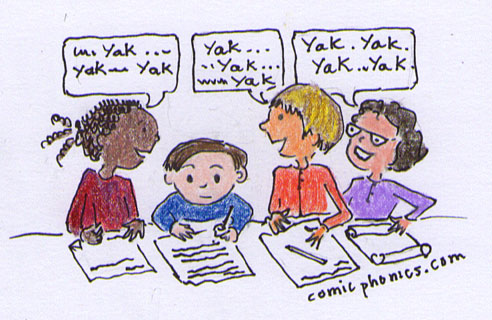
One student working while those nearby are talking

Some situations are more conducive to flow than are others. A quiet background helps. That could mean complete silence or the sounds of nature such as a recording of ocean waves or bird sounds. A writer needs to be able to hear the words in his mind, and sometimes he needs to hear the words aloud. Libraries can be good places to write first drafts; so can picnic tables in the back yard.

A noisy background can also be conducive to flow providing the noise continues at about the same degree of low noisiness. Many writers prefer to write in coffee shops or diners with the background chatter of customers and waiters. A vacuum cleaner or hair dryer on in another room—just left on, with no one using it—can help writers to focus.  So can classical music.

It’s the interruptions that make writing difficult and end flow.

For writing a first draft, flow can be important. For revising, flow can be important as well, but it is usually less important than it is for composing a first draft. For editing, flow is usually not important.


A revised first draft showing cross outs, arrows, circles and erasures means the student has truly improved the essay

Every professional writer knows that the real work of writing happens during revision. But this is an idea that students—and parents—need to learn. If a student says she has finished revising and her copy seems little altered, then she has probably not done a good job at revision.

On the other hand, if a student looks at her copy, noticing cross outs, arrows to side margins or to the back of the paper, words squeezed in, circles to identify verbs and first words of sentences and perhaps even sections cut apart and taped together in a different order, the student has truly revised.

Below is an example of the first page of a fourth grader’s messy but revised essay.

draft showing revisions 001

Revising is not editing. Revising means making substantial changes in the writing in order to improve it. Editing means looking for finer details such as correct spelling, apostrophes in the right spaces, and hyphens used appropriately. Unfortunately, in many school classrooms, students don’t learn to revise; they learn to edit.

Parents can be dismayed if they see the writing of my students while revising is in progress. Parents expect me to make the student edit too early on in the writing process. “Shouldn’t he change the spelling now?” a parent might ask, looking over his child’s shoulder.

When I work with children of parents like this, I show them examples of other students’ work, including the final draft. I let them see that the tiny errors will be corrected eventually. Usually this suffices until they see their own child’s finished work. Then they are sold on this writing process.

Perfectionist students might never reach the stage of good revising unless they learn to tolerate a degree of mess. I worked with one student who needed to start over so many times that she never completed a single essay. I have worked with other perfectionists who learned that the mess increases their chances of a higher grade, and so they set their sights on the perfect grade and begrudgingly accepted the interim mess.

Next we will talk about flow and how to make it happen.

Identify the range of the sentence lengths to increase the variety of sentence lengths and reader interest

The range of sentences means the sentence with the largest number of words minus the sentence with the smallest number of words. That number is the range.

Knowing this number can be useful.

• If the range is in the single digits, that means most of the sentences in a piece of writing are about the same length. The reader will find the writing boring, though the reader might not know why.

• If the range is in the high teens or twenties, that means there are some longer sentences and some shorter sentences. This range shows the writer has used a variety of sentence lengths. The reader will find this kind of writing interesting, though again, the reader might not know why.

Most students need to increase the range of their writing. To do that, students need to be aware of sentence range and to force themselves to write sentences of varying lengths.

When elementary school-aged children write, most of their sentences are ten words or less unless they are writing a sentence that includes a series or they are compounding sentences. So the range for such children usually is a low number—maybe nine or less. Older students write longer sentences, but again, usually their range is a low number—maybe twelve. Experienced writers might have a range in the twenties. But in order to get such a high range, writers must have a sentence with 26, 27, or 28 words, and another sentence with just a handful of words.

Notice the following introduction to an essay written by a fifth grader:

Have you ever played Monopoly? If you have,
then you know all about it. If you have not,
then let me describe Monopoly to you.

The first sentence has 5 words, the second sentence has 9 words, and the third sentence has 11 words. 11 minus 5 gives a range of 6. If the rest of the sentences in this essay are about 5 to 10 words long, the range would be small and the essay would be stylistically unappealing.

Compare that to the beginning of a narrative written by a rising second grader:

Once when I woke up I found a baby unicorn in
my tiny bed. It looked as tall as me with a tail
and wings, a purple and pink horn, and a white
and yellow body. Right away I jumped on the
unicorn and flew to a castle that is made out of
glass. She said I owned the castle.

The first sentence has 14 words; the second has 22 words; the third has 18 words; and the fourth has 6 words. 22 minus 6 gives a range of 16, an excellent range for such a young writer. Notice also that all four sentences vary in length by 4 words or more. Analyzing only sentence lengths, the second selection is stylistically more interesting than the first.

By combining sentences or adding more detail, students usually bump up the number of words per sentence. For some students, increasing the number of words per sentence and eliminating all short sentences can become an obsession. This is a mistake. Including short sentences is essential to good writing.

Did you notice in the last paragraph that a nineteen-word sentence was followed by a four word sentence? Often, a really short sentence after a long sentence can add style to writing. Students need to see examples of this kind of writing to know that it is not only okay, but desirable. Below is an example of a 36-word sentence followed by a 9-word sentence (a range of 27) from Because of Winn-Dixie by Kate DiCamillo.

Me and Winn-Dixie got into a daily routine
where we would leave the trailer early in
the morning and get down to Gertrude’s
Pets in time to hear Otis play his guitar
music for the animals. Sometimes Sweetie
Pie snuck in for the concert, too.

When a student uses dialog, the number of words per sentence plummets since most characters, like most real people, speak in short sentences, phrases or single words. Dialog should sound natural. But students fixated on the number of words per sentence might want to eliminate dialog in order to maintain a high number of words per sentence. Again, this is a mistake. To counter this tendency, when I ask students to calculate the number of words per sentence, I allow them to eliminate any sentence with dialog in them. On the other hand, when students calculate the range, they should include short sentences with dialog.

In the next blog we will talk about the mess all this revising creates in a student’s draft.

Add metaphors and allusion to add sensory details and style

We talked about how adding alliteration, simile and hyperbole can improve the number of details and style of writing. These three figures of speech are usually the easiest for children to fit into their writing, but with practice, other kinds, including metaphor and allusions, can become easy.

Metaphors are indirect comparisons. “Like” and “as” are not used, causing children to wonder how to incorporate metaphors into their writing. Start by using “is” and say something is something else, especially if the something else seems odd or far-fetched. For example, “My dog is my guardian angel.” Or, “My cat is a mouse exterminator.” Or, “My dog is my alarm clock.”

a mountain of books to read

A mountain of books to read.

Next, try leaving out “is.” “My guardian angel, Buster, smelled the fire before I did.” “On the farm, Angel transformed from a sweet, purring friend into a mouse-pouncing exterminator.” “Buster, my alarm clock, keeps me on time for the school bus.”

Metaphors usually require more practice than similes, but they are powerful sensory comparisons, capable of bringing more style than similes do to writing.

Allusions are references to commonly understood myths, stories, people or works of art. The Bible and Shakespeare’s writing are commonly used as allusions in the West. But there is no reason Harry Potter, Percy Jackson or Goldilocks can’t be used. For example, if a child is writing about an annoyed mother, who is telling her son to come out of his room, the mother could say, “You better come out or I’ll huff and I’ll puff and I’ll blow your door down.” Notice that in this example, the big, bad wolf from the Three Little Pigs is alluded to but not named. Or in describing a big sister, a young writer could say, “She has the looks of Sleeping Beauty and the brains of Hermione Granger.”

To make an allusion work, the writer must know his audience well enough to believe that his readers are familiar with the reference he is making; if not, the allusion is lost. Even if every reader isn’t in on the allusion, child writers should be encouraged to try them. J. K. Rowling used allusions when naming some of the characters in her books. For example, by naming Professor Snape with a name that sounds so much like snake, J. K. Rowling intends readers to think of bad, snake associations.

Most rubrics for student writing include figures of speech as desirable elements to improve the style of a student’s writing. But on their own, most students don’t think to include figures of speech in their writing. These elements must be practiced and pointed out to make the student comfortable with them.