Monthly Archives: July 2014

Use a prewriting organizer to write the first draft

After helping students create a good prewriting organizer, I sometimes see students begin their first drafts with no prewriting organizer in sight.  “Where is it?” I ask.  They dig through their writing binder and find it, hidden somewhere.

This is a graphic representation of a third grade student's handwritten mind web.

The best prewriting organizers for expository and persuasive essays are mind webs (click the graphic for more information).

This tells me that those students are not used to writing an essay with a prewriting organizer.  They don’t know how to use it.  I can’t assume that “If they write it, they will use it.”  They need to be taught how to use it.

I insist that the prewriting organizer be situated to the side of the notebook paper on which the student is writing his first draft.  To show me that he is using the prewriting organizer, I ask him to cross out lightly the ideas as he includes them in his essay.  By the time the essay is done, all the ideas on the prewriting organizer should be crossed out.
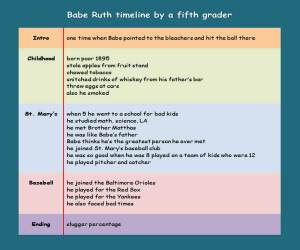
An example of a modified timeline organizer on Babe Ruth's life--childhood, school years, and baseball career.

Use a modified time line as a prewriting organizer for narratives (click the graphic for more information).

If a student is coming in cold after creating a prewriting organizer the day or the week before, I ask her to read the prewriting organizer to herself in the order in which she has numbered the subtopics.  This warms up her brain and reminds her of the details and the scope of her essay.

While she is writing the first draft, I usually allow the student space, looking over her shoulder occasionally.  If she is making progress, I leave her alone, but if she seems stuck, I intervene.  The most common problem is how to start body paragraphs.

Use a chart for comparison and contrast essays.

For comparison and contrast essays, use a chart or a Venn diagram as a prewriting organizer (Click on the graphic for more information).

We reread the information planned for the paragraph and see how it relates to the essay topic, and from this we write a topic sentence.  If a student has not written an essay before, I offer more help than I do for experienced writers.

Sometimes students recognize that they should change the order of their subtopics.  Before beginning the rough draft is a good time to do that.  Just cross out the numbers on the organizer and write new ones.  Sometimes students recognize that they have little to say about one subtopic, but they can think of another one with greater detail.  This is a good time to make that change.

Sometimes the student has lost interest in the topic of the essay completely and wants to change topics before he begins the first draft.  Usually I let him discard the completed organizer and start over.  You might think that creating that organizer was a waste of time, but no.  The student has practiced organizing an essay, an essential skill of a good writer.  Not every planned essay needs to be written.

In our next blog, we will talk about the conclusion, another difficult part of the essay for many students to write.

Does every sentence need a transition? No!

Is anything wrong with this paragraph?

Paragraph using obvious transition words.

Every sentence in the above paragraph begins with a transition word.  This is how many students are being taught to write, as if the reader cannot follow the sequence without reminder words at the beginning of each sentence.  In the above case, the words are obtrusive, calling attention to themselves, but they could be more glaring if the student had used “Secondly,” “Moreover,” “Furthermore,” “Additionally,” and “In conclusion.”

In student text books, transition words are listed by type:  chronological (first, next, then, later, finally), comparison (and, also, similarly, like, additionally), contrasting (however, but, rather, in contrast, although), and showing cause and effect (as a result, therefore, consequently).  Students are taught to use one of these transition words at the beginning of almost every sentence.  They are led to think they must use a single word or phrase that is not organic to the writing or they don’t have transitions.  Their writing becomes bloated with these needless, distracting words.

Is there a better way?  Yes!

Look back at my last paragraph which begins with “In student text books.”  Can you find a transition?  In the second sentence there is one transition word, the word “transitions” itself.  The first sentence mentions transition words, so when the second sentence repeats the word “transition,” that is a subtle yet useful connection to the information in the previous sentence.  The third sentence uses the word “transitions” again, as well as the word “they” to refer back to students in the previous sentence.  In the final sentence, “distracting words” refers back to “transitions.”  So as you can see, there are several transitions, but none calls attention to itself.  Rather, each does what transitions are supposed to do: subtly organize ideas to keep the reader following clearly.

How can students improve their use of transitions?

  • Teach the student not to start every sentence with an obvious transition word.  If the student must use transition words that are not organic to the writing, tell her to tuck them into sentences rather than highlighting them at the beginning of sentences.
  • If students frequently use beginning sentence transitions, ask the students to cut out half of them; then ask them to cut out half of the rest.
  • Ask students to eliminate most multisyllabic transitions.  “And,” “but,” “so,” and “since” do the job just as well as “additionally,” “however,” “therefore,” and “because” without drawing attention to themselves.  In general, the more syllables a transition has, the more obtrusive it is.
  • Most of the time, the student should repeat words, or use pronouns to refer back to words or ideas already mentioned.  Those repeated words or pronouns become organic transitions.

Compare the paragraph about rocks at the beginning of this blog with the same paragraph using more subtle transitions:

Repeating words and using pronouns as transitions.

Click on the graphic to see a comparison of the two paragraphs.

In our next blog, we will talk about using the prewriting organizer to write the first draft.

The five sentence paragraph

Why the five sentence paragraph?  One reason is that teachers seem to think five sentences are long enough to explain a subtopic, but not too long.  One or two sentences seem skimpy, while seven or eight sentences might seem unduly long.  Five is just right.

Limiting students to five sentences straitjackets their writing.
Teachers also think 25 sentences give them sufficient material to judge the student’s writing skills.  In other words, twenty-five sentences meet the teachers’ need for evaluating student writing.

But I think limiting students to five sentences straitjackets their writing.  For example, I encourage students to use dialog to enliven their essay writing.  But when they find out that each time the dialog shifts from one person to another a new paragraph is needed, they freak out.  “But then I will have too many sentences.  And too many paragraphs!”

Sometimes students think up an excellent example that cannot be neatly stated in four sentences to follow the topic sentence of a body paragraph.  They tend to skip that example and settle on something less detailed and less good in order to limit their paragraph to five sentences.

When as a writing tutor I am working with students who know that their teacher demands five sentences per paragraph, I back off.  But when I am working with students who are writing to improve their skills, I encourage breaking this lockstep format.

Next we will discuss transitions.