Writing introductions can be so hard.

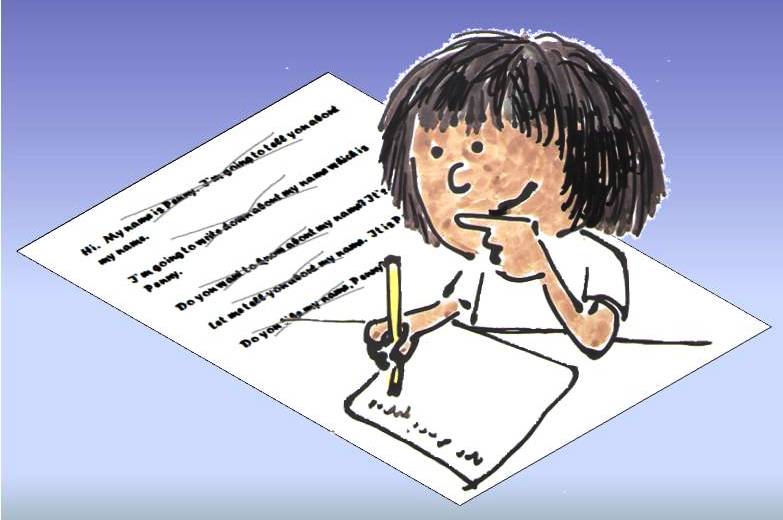
Even with detailed prewriting organizers, many students have no idea how to begin an essay. They stare at that empty notebook page for ten or twenty minutes. Then, in desperation, they either introduce themselves (“Hi. My name is Sid. I’m going to tell you about my pet dog.”) or they write a question (“Do you want to know about my pet dog?”).
Writing introductions can be hard.

When I see a student having difficulty beginning an essay, I suggest several options. “My pet dog just had a litter of puppies. Two of them are black, one is brown and one is spotted. We named the spotted one Spot but we are still thinking about what to name the others.” Or, “Spot is such a dumb name for a dog, but that is what my little sister called one of our new puppies. I wanted to call the puppy ‘Blob’ but my mother said no.” Or, “If you name a puppy, does that mean you get to keep it? My little sister wants to keep one of the puppies from our big dog’s litter, so she named it Spot.”

Sometimes students use one of my suggestions, but more often they modify one of them. I never write down the introduction for them; they need to listen to my suggestions, and write their own introduction. My job is to get them thinking of options. Their job is to write the introduction.

In upcoming blogs, I will talk about various kinds of introductions, but for now I hope to point out how difficult writing an introduction is for some students. Think of it this way: You go to a party and you don’t know anyone. How do you begin a conversation? Do you wait for someone else to start? Do you move around the fringes of groups and listen for a topic you know something about? Do you head for a shadowy corner?

Beginning the essay, even armed with a detailed prewriting organizer, can be daunting. But when students have written a handful of essays, this task usually eases. Sometimes they write an introduction and then call me over to ask my opinion. I see this as a giant step forward for a student since he has taken the initiative to begin.

What if the student writes, “Hi. My name is Sid. I’m going to tell you about my pet dog.” I let it go until later, after the essay is complete. Then I explain that sometimes we need a crutch to begin writing, and that this kind of beginning is a crutch. I say, “What if we cross out ‘Hi. My name is Sid. I’m going to tell you about my dog.’ Instead, what if we start the essay with what comes next?” Almost always what follows is a better beginning, and almost always the student can see that. I have seen students begin essays with “Hi. My name is. . .” and then cross those words out themselves once they understand those words are a crutch they need to use to get themselves going.

And what about boring question beginnings? Students need to know that there is nothing wrong with a question, but it needs to be a question that sparks interest. Instead of, “Do you want to know about my dog?” I help students change the question into one which might get “yes” for an answer. “Do you want to know what it’s like to watch a dog have babies?” “Do you know what a mother dog does right after her puppies are born?” “Do you think having five kids at a time is normal? Well, it is for my dog.”

In our next blog, we will talk about useful types of introductions.

For comparison and contrast essays, use a chart or a Venn diagram as a prewriting organizer.

How are Percy Jackson and Harry Potter the same?  How are they different?  How are an iPhone and a Droid the same?  How are they different?  How are elementary school and middle school the same?  How are they different?

For essays like these, where one concept needs to be compared (to show similarities) and contrasted (to show differences), a simple chart or a Venn diagram is easy for children to create and does the job well.

sharks_comparison_chart

Click on the graphic to enlarge it.

For the chart organizer, draw two vertical lines on notebook paper, creating three columns.  Use the first column to list ideas to be compared or contrasted and the other two columns for the ideas being contrasted (for example, WWI and WWII).  Similarities can be written over the line separating the second two columns.

For the Venn diagram organizer, start with two huge circles that overlap by a third.  On their own, students draw circles that are too small and that barely overlap.  Instead, I have them trace a seven or eight inch bowl whose shape fills about two-thirds of a page of notebook paper.  If two seven-inch circles are traced, overlapping in the middle, the result is enough room for the three kinds of information needed in the essay:  how each concept differs (the outer parts of the circles) and how each concept is similar (the overlapped part).

For students comfortable with mind webs, I recommend using Venn diagrams.  The circles of the Venn diagram look something like a mind web and bring continuity to the prewriting experience.  If there is not enough room in the circles, we tape another paper to the bottom or side of the page and add more information there.  But a chart works just as well for students who prefer that way of organizing.

When the chart or diagram is full, I ask students to use colored pencils to identify information that should go together in the same body paragraphs.  Students might circle Harry Potter’s and Percy Jackson’s ages in red; where they live in red; where they go to school or camp in red and when the stories take place in red.  They might circle their friends in blue.  They might circle their tasks or actions in green.  Then they number the colors to show what kinds of information they plan to use in the first, second and third body paragraphs.

Essay on sharks by a third grader.

To enlarge, click on the photo.

Previous blogs have covered why prewriting organizers are important, and how to construct and use easy kinds of organizers for expository and persuasive essays (mind webs) and for narratives (modified time lines).  Now the student is ready to begin the first draft.  Next time we will talk about introductions.

Use a modified time line as a prewriting organizer for narratives

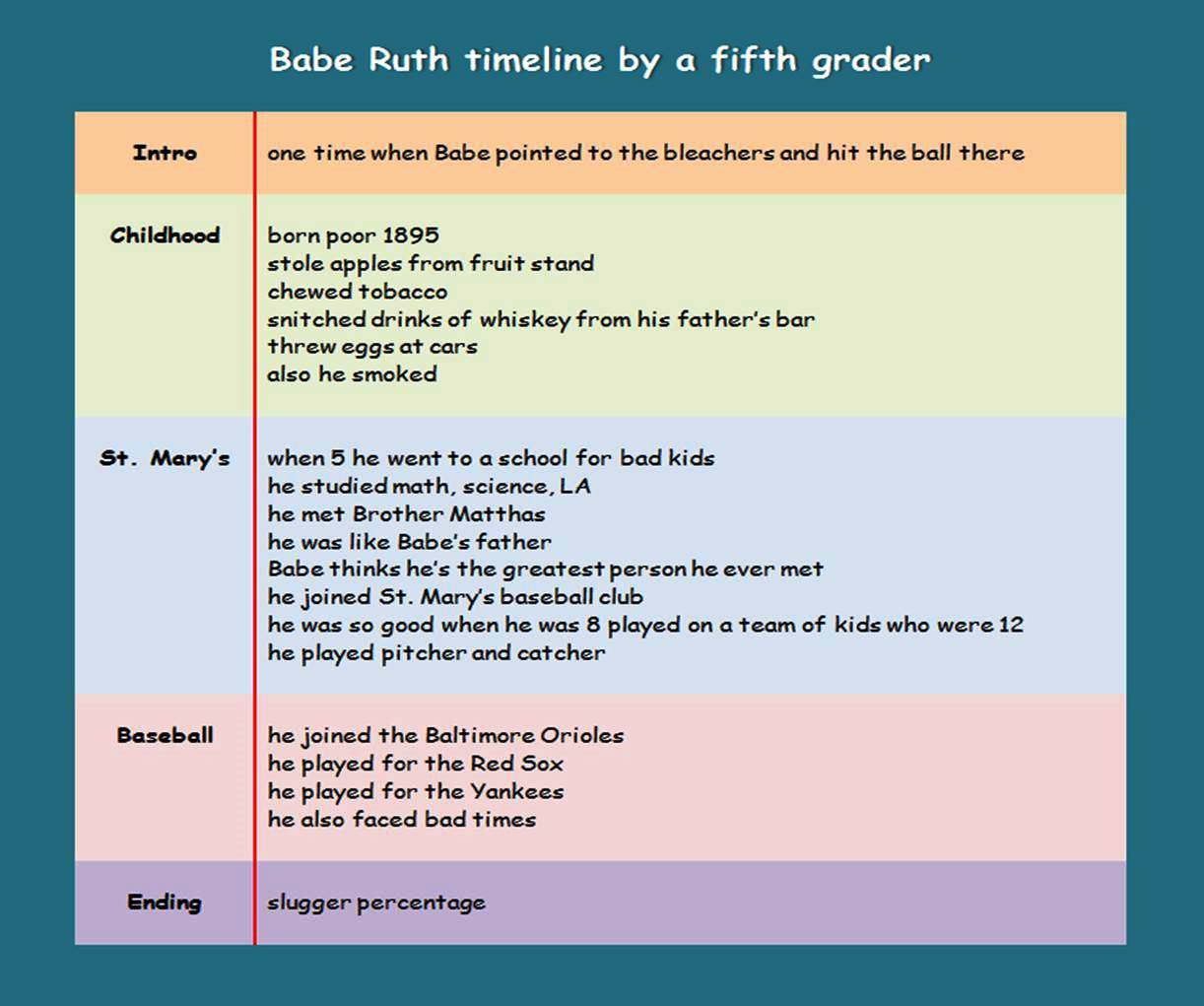
Narratives tell stories, either fiction (a detective story, for example) or nonfiction (the life of a butterfly, a biography, or a trip, for example). For students, those stories are clearest if they are written in chronological order. So I recommend a modified time line to plan those stories.

The kinds of time lines used in history classes are detailed with dozens of dates. That is not what I mean by a modified time line. I mean a beginning, middle and end.

  • At the top of a page of notebook paper, I ask students to write the word “beginning.” If the story is fiction, just under the word “beginning” I instruct them to write “setting—place and time, characters, opening scene, and problem to be solved.” The student writes down that information, not in sentences, but just in phrases or snippets that he can go back to later to develop his story.
  • If the story is nonfiction, the student might label the beginning, middle and ending differently. The labels might be “childhood, school years, adulthood” or “before the war, during the war, while president” or “foal, colt, stallion.”
An example of a modified timeline organizer on Babe Ruth's life--childhood, school years, and baseball career.

Click on the graphic to enlarge it.

  • For a fiction story, most of the detail will happen in the middle part. Here the student will add more phrases, snippets, arrows, cartoons or whatever helps him organize the action of his narrative.
  • For nonfiction, the three or more parts might all be about the same size. Or there might be more than three parts, but for beginning writers, I recommend three parts. Three seems doable.
  • A few lines up from the bottom, I ask the student to write the word “End” if the story is fiction. Next to it the student writes “Resolution.” Here the student writes down how his story will end and any ideas that need to be explained.
  • If the story is nonfiction, again there should be a clear ending to the story.

Easy? You bet. Does it work? Yes, if there is enough detail. I don’t let the students begin writing unless there are about ten or more ideas or steps in the beginning and middle parts. For new students, I ask them to explain one or two of these steps to be sure they are thinking the narrative through. When they discuss it with me, I suggest more ideas for them to write down, so that they see the degree of detail I hope they will include in their stories.

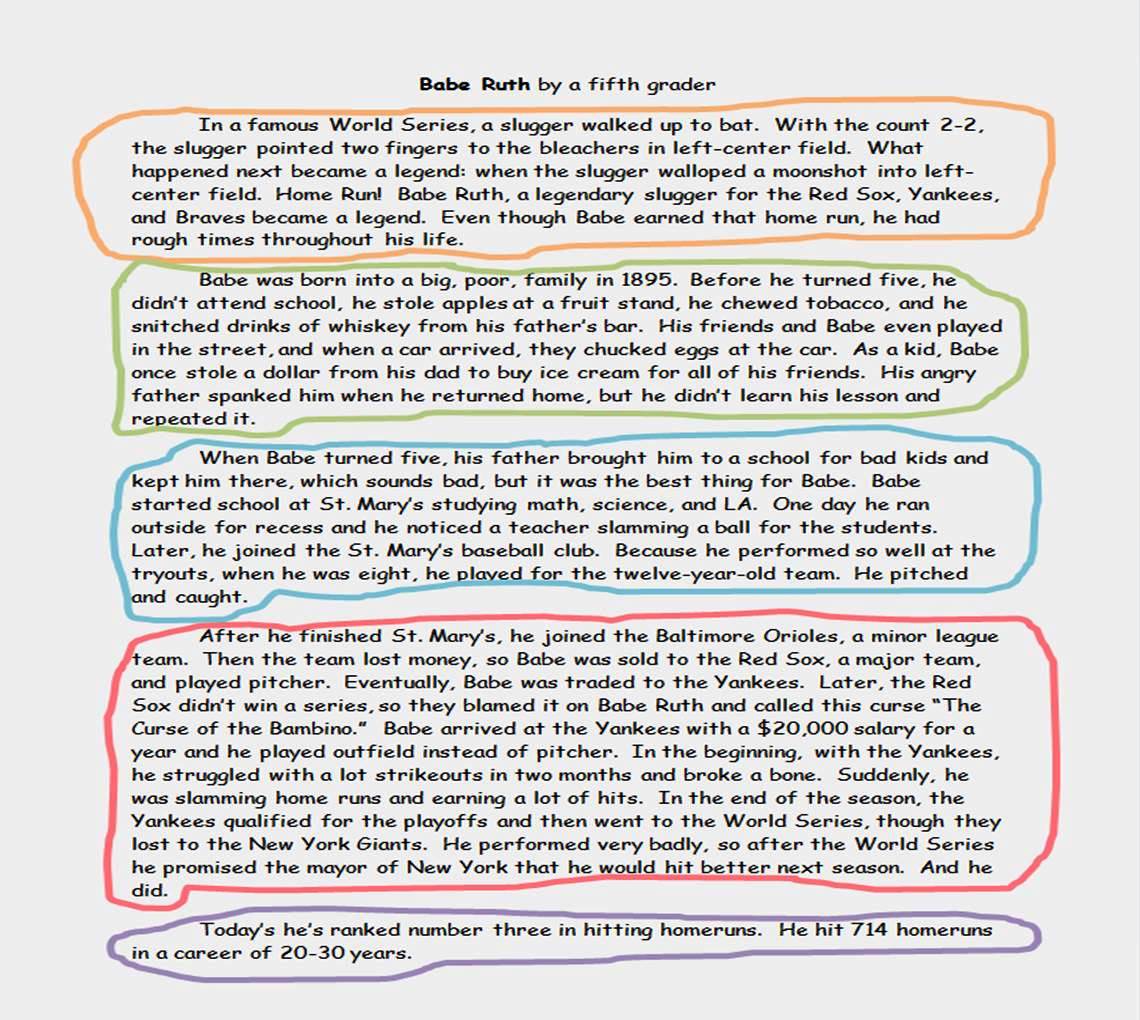
Completed Babe Ruth essay using the timeline example.

Babe Ruth essay from the modified timeline organizer example. Click on the essay picture to enlarge it.

Since many students enjoy writing detective stories, the “resolution” becomes how to solve the case. For students traveling in space, the problem is to get home or to the new planet or to save someone. But the problem can be simpler: how did Abraham Lincoln die, or where does the mother bear go in the winter to have new cubs. The ending of the narrative should satisfy both the reader and author.

Comparison essays are another type students are often asked to write. In the next blog, we’ll talk about an easy prewriting organizer for them.

The best prewriting organizers for expository and persuasive essays are mind webs.

I define best using two criteria:

  • the kind of organizers students are likely to use because they are easy, and
  • the kind of organizers that keep the writer focused on one main idea and relevant details.

Many students skip using a prewriting organizer because they think that using one is difficult and a waste of time.   In fact, what they might be rebelling against are the kinds of prewriting organizers that teachers recommend.  Formal outlines are incredibly difficult for students to use, yet some teachers insist on them.  I never use them, and I am a professional writer.   Why would I when there are easier approaches that do the job better?

Nearly every student I have tutored  had a teacher who suggested a unique organizer.  Students move from fourth grade to fifth grade to sixth grade, and each time students need to learn a new type of organizer to please their teachers.  This frustrates students needlessly and doesn’t lead to good essays.

This is a graphic representation of a third grade student's handwritten mind web.

This is a graphic representation of a third grade student’s handwritten mind web (click on the picture to enlarge it).

What I recommend to my students who write expository (informational) and persuasive essays is to use a mind web organizer, sometimes called a spider web.  The student writes the single topic of the essay in the middle of the paper, and then, like spokes of a bicycle wheel, draws two, three or four lines out from the topic.  At the ends of these lines, the student writes the subtopics he will develop.  Then from each of those subtopics, he draws new “spokes,” naming the details he wants to use to explain each subtopic.

Beginning students need to be walked through these steps.  Often I start the web by asking the student questions to find out what the subdivisions will be and to begin finding details.  Then I hand over the unfinished web to the student to finish.  Modeling is an important way to show the student the kind of detail he needs to develop.  In general, beginning writers use too many generalities and too few details.  They need someone to model how to find and write down details.

After the mind web is complete, I ask my students to encircle each mind web subheading and its details in a different color, using colored pencils, markers, or crayons.  Using color is a visual way to connect details that belong together.  Students can see immediately which subheadings have too little development and can add more details before they write.  Lastly, I ask students to number each colored group of ideas in the order in which they want to write about them in the essay.

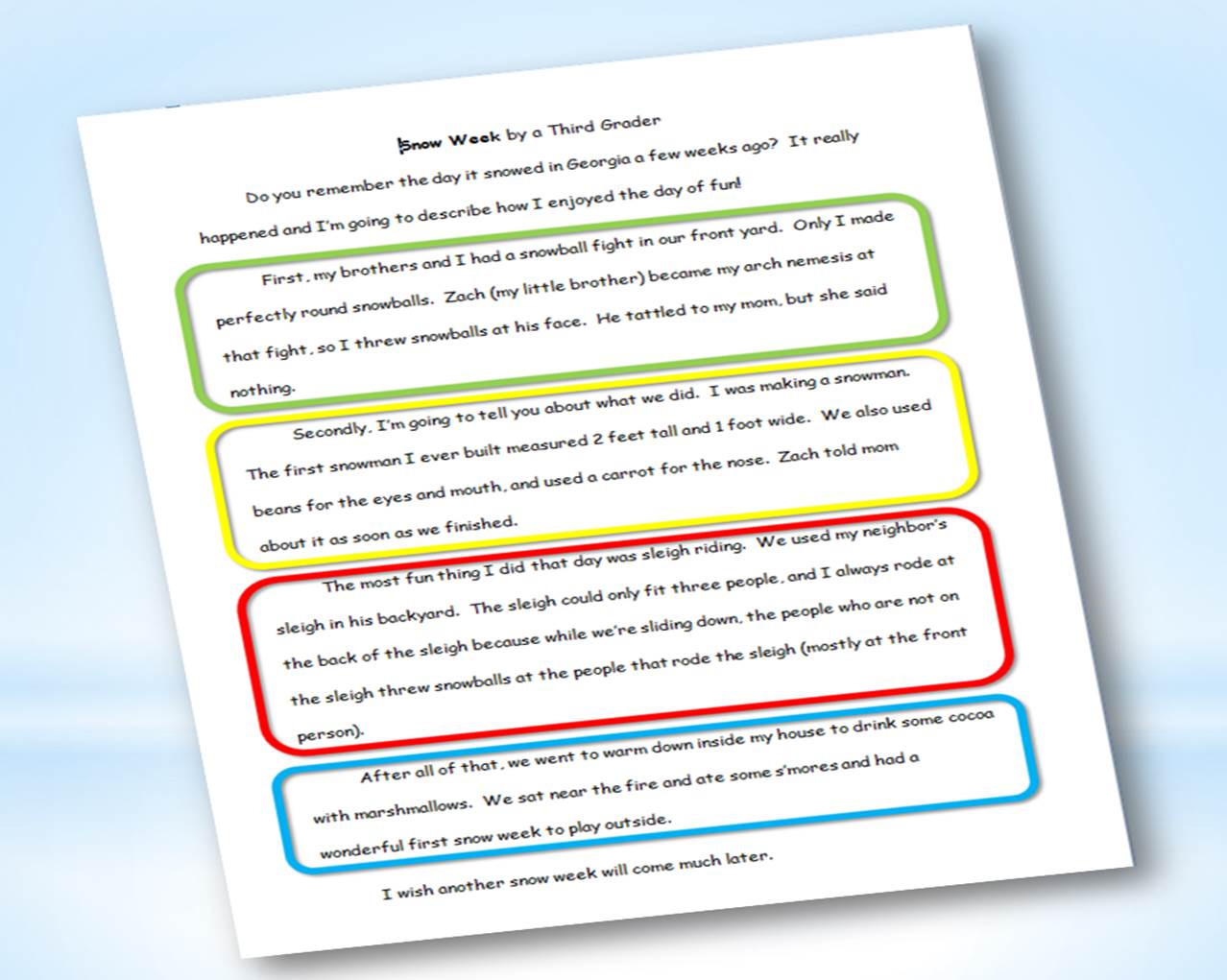
Here's the finished essay using the "Snow Week" mind web organizer(click the picture to enlarge it).

The colored borders were added to the final essay to show which essay paragraphs match up with the encircled mind web ideas(click on the picture to enlarge it).

Why does as mind web organizer work?

  • With a single idea centering the web, the student is forced to write about one idea only.
  • With two, three, or four subtopics (never more than four or the essay becomes more a laundry list than developed thoughts), the student is forced to break down the topic into a few explaining ideas (expository essays) or reasons (persuasive essays).
  • The looseness and scribble-like quality of the mind web relax the student into thinking, “I can do this.”  Students turn the paper sideways when they run out of room, or draw arrows to indicate information on the back, or tape another paper to the side and extend the web to a second page.  The mind web expands endlessly, encouraging the student to add more details.
  • Because the structure is loose, students can add more details as they think of them, even after they begin their first drafts.  Change is always possible with a mind web.

The result is a detailed prewriting organizer about a single topic.  Sometimes it looks a mess, but the only ones who need to read it are the students and I.  When parents first see the mind webs of their children, shock crosses their faces, but later, when I show them the writing that the mind webs lead to, their surprise turns into smiles.

Mind webs are easy and they work for expository and persuasive essays, two of the main kinds that students need to write. But what kind of organizer works for narratives? We’ll talk about that in the next blog.

Prewriting organizers are essential

Many students think they can skip writing down a prewriting organizer, or that scribbling three or four words is enough planning before they begin their first drafts. But as a teacher, I can tell immediately when students have not thought through their essays before writing.   In those essays,

  • the writing sounds off-the-top-of-the-head;
  • the ordering seems haphazard;
  • the number of details is too few, too general, or lopsided; and
  • the essay strays from one main idea.

Essays are thoughtful presentations of ideas, not dream-like narratives. A stream of consciousness method of writing does not work for essays. Essays must be organized, and that plan of organization must be evident to the reader from the beginning of the essay.

Methods of grading student essays (rubrics) allocate up to 2/5 of the final grade for a combination of developing a single idea and organizing that idea in a clear manner. That’s 40% of the grade.

Think of the prewriting organizer as a recipe to follow to write an essay. Would you mix the ingredients for a new kind of cookies without a list of those ingredients? Would you combine the ingredients in any old order?

Or think of the prewriting organizer as Lego instructions for a new spaceship. Could you ignore the instructions, put together the Lego pieces any which way, and hope to end up with the spaceship on the box’s cover?

What kind of prewriting organizers work best? We’ll talk about next.