Category Archives: English Writing Instruction

Writing well takes study and practice.

How to replace weak verbs with strong ones

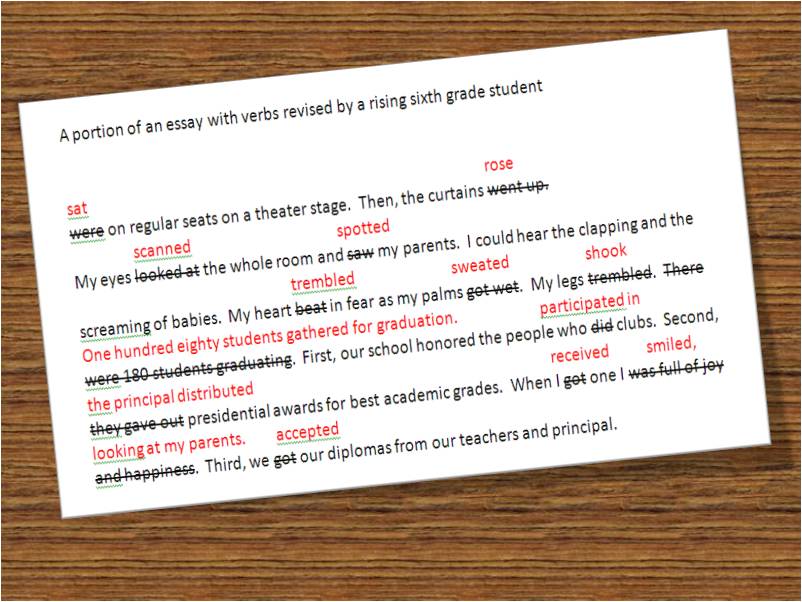
Excerpt from a student's paper showing revised verbs.

Click on the picture for an enlarged version.

Replacing weak verbs with strong, specific ones is the key to good writing.  When new writing students begin with me, I work one-on-one with the students on this skill over and over to be sure they understand its significance and how to do it.

First, the student identifies the verbs used in the piece of writing, and lists them with tally marks to show how often the student used them.  To revise, we start with some easy words to replace, such as get, go, do, make and take.  The verbs are already encircled with color in the essay, so it is easy to find one of those words.  The student reads the sentence aloud, and I ask if he can think of any word to replace the weak verb.

In the sentence, “I go to JFK Elementary School,” for example, the student ponders the word “go.”  “I take classes in,” he might suggest.  With more prodding he might say, “I study in.”  I might accept that in a third grader, or I might suggest the word “attend” for an older student.  He crosses out the word “go,” and writes “study” or “attend” in the space above the crossed out word.  Then we move on to the next word.

In every revising lesson, I ask the students to use a thesaurus.  Many students have not used a thesaurus (or dictionary) before (except online), so this becomes a mini lesson on how to use those resources.  For the sentence, “I gave the dog a bath,” the student needs to know that a verb is always listed in the present tense, so the word to look up is give, not gave.  I explain that because “give” is so general, there are many meanings listed.  The student cannot pick any one.  He needs to choose a meaning that works for the sentence.  Sometimes we discuss which word works best based on many factors such as the child’s age, his grasp of vocabulary and the degree of formality of the writing.

Rarely does the student replace every weak verb.  Since I am teaching the student a process, nailing each verb is not my goal.  Learning that weak verbs should be replaced, and knowing how to replace them, is.

The hardest verb to replace is the verb “to be.”  We will talk about that in the next blog.

To revise, replace weak or overused verbs with strong, specific verbs.

overused verbs list

When revising, I ask students to encircle each main verb (not helping verbs).  Then, on a separate paper, students make a list of the verbs, using tally marks to show how many times each verb is used.  Usually I help them to write the first list.  Present, past, future—all forms of a verb are treated as the same verb.  Many students are not aware that “is,” “are,” “was,” “were,” “be,” and “been” are the same verb, so I often write those words together at the top of the paper, as well as “have,” “has” and “had”; “do,” “does,” “did;” “go” and “went.”

After the list with its tally marks is complete, I review the first draft, looking for verbs the student has not found.  Younger students sometimes don’t know what verbs are, so this is a learning experience for them.  Older students often miss identifying the verb “to be.”  I encourage independence, but I step in when the student doesn’t know what to do.

With the students looking at their completed list of verbs, I ask, “What do you notice?”  I hope they say something like, “Well, I used an awful lot of get and got, and also is and are.”  The point is for the students to recognize that they have overused some verbs.

How many is too many?  In a typical piece of student writing of two, three or four double spaced pages, three or more uses of the same verb is too many for my purposes, but there are exceptions.

  • I point out that we are stuck with repeating some verbs which haven’t many synonyms. “Play” is such a verb.  How do you say, “I play the piano” or “I play soccer” without using the word play?
  • Other weak verbs should be replaced even if there is only one of them. “Get,” “take,” “make,” “come,” “go,” “have,” and “do” are vague in meaning and can usually be replaced with more specific verbs.
  • When a verb is used as part of an idiom, it can be hard to replace, and I often allow such verbs for younger children. For older kids, I ask if there is another way to say the thought without using an idiom.

Now comes the most important work of revising:  replacing weak verbs with strong ones.  More on that in the next blog.

Use the “full circle” approach for an essay conclusion

The introduction and the conclusion are usually the two most difficult parts of the essay for a student to write.  When it is time to write the conclusion, I always suggest rereading the introduction because the introduction and conclusion should support one another.  “Going full circle” is a common idea in writing—starting with one main idea, developing many subtopics, and returning to the main ideas to end.

Here are some ways to do that, using the “when I lost a tooth” topic from a previous blog.  If you can include humor in your conclusion, and leave your reader with a smile, that is the best ending possible.


Anecdote introduction:

My Grandpa says he doesn’t remember when his first teeth fell out but he remembers when his last one did.  It was after he cracked a walnut with his teeth, and a back tooth broke apart.  He had to go to Dr. Taylor’s office to have the rest of the tooth pulled out.

Anecdote conclusion:

Grandpa says I should bite into a walnut with my wiggly tooth.  And I’m tempted after seeing Grandpa’s teeth in a glass on his nightstand.  What if I lost all my teeth and not just the wiggly one? Imagine all the money the tooth fairy would bring me!


Dialog introduction:

“Hey, Mom, how much did the tooth fairy bring when your teeth fell out?”
“A nickel a tooth.”
“A nickel a tooth!  That’s all?”
“That’s all.”
“Didn’t they invent quarters back then?”

Dialog conclusion:

My mother got a nickel, my older cousin got a dime, and my big sister got a quarter.
“Mom, what’s the chance of me getting a half dollar for my loose tooth?”
“Pretty good, honey.”
Sometimes it’s great to be the youngest.


Statistics introduction:

When I was in first grade, every single kid lost a tooth, and most of us lost more than one.  Billy Emsing was the champion though.  He lost seven teeth that year.  I remember because we kept track with a bar graph on the bulletin board.

Statistics conclusion:

Now that I’m starting fifth grade, no one is losing their teeth any more.  But some kids, like me, are starting to sprout up.  Maybe I could get my teacher to post a bar graph of the number of inches we grow this year.  With my dad being six feet two inches, I have a chance of winning that contest!


Startling claim introduction:

Suppose you brush your teeth for a minute in the morning and a minute in the evening every day this year.  That’s 730 minutes, or more than 12 hours standing in front of a sink brushing your teeth.

Startling claim conclusion:

Twelve hours brushing teeth in one year times 80 years is about 960 hours in a lifetime.  That’s 40 days of our lives spent brushing our teeth.  Yikes!  I better buy a strong toothbrush.

In the next blog we’ll look at some other kinds of conclusions.

Does every sentence need a transition? No!

Is anything wrong with this paragraph?

Paragraph using obvious transition words.

Every sentence in the above paragraph begins with a transition word.  This is how many students are being taught to write, as if the reader cannot follow the sequence without reminder words at the beginning of each sentence.  In the above case, the words are obtrusive, calling attention to themselves, but they could be more glaring if the student had used “Secondly,” “Moreover,” “Furthermore,” “Additionally,” and “In conclusion.”

In student text books, transition words are listed by type:  chronological (first, next, then, later, finally), comparison (and, also, similarly, like, additionally), contrasting (however, but, rather, in contrast, although), and showing cause and effect (as a result, therefore, consequently).  Students are taught to use one of these transition words at the beginning of almost every sentence.  They are led to think they must use a single word or phrase that is not organic to the writing or they don’t have transitions.  Their writing becomes bloated with these needless, distracting words.

Is there a better way?  Yes!

Look back at my last paragraph which begins with “In student text books.”  Can you find a transition?  In the second sentence there is one transition word, the word “transitions” itself.  The first sentence mentions transition words, so when the second sentence repeats the word “transition,” that is a subtle yet useful connection to the information in the previous sentence.  The third sentence uses the word “transitions” again, as well as the word “they” to refer back to students in the previous sentence.  In the final sentence, “distracting words” refers back to “transitions.”  So as you can see, there are several transitions, but none calls attention to itself.  Rather, each does what transitions are supposed to do: subtly organize ideas to keep the reader following clearly.

How can students improve their use of transitions?

  • Teach the student not to start every sentence with an obvious transition word.  If the student must use transition words that are not organic to the writing, tell her to tuck them into sentences rather than highlighting them at the beginning of sentences.
  • If students frequently use beginning sentence transitions, ask the students to cut out half of them; then ask them to cut out half of the rest.
  • Ask students to eliminate most multisyllabic transitions.  “And,” “but,” “so,” and “since” do the job just as well as “additionally,” “however,” “therefore,” and “because” without drawing attention to themselves.  In general, the more syllables a transition has, the more obtrusive it is.
  • Most of the time, the student should repeat words, or use pronouns to refer back to words or ideas already mentioned.  Those repeated words or pronouns become organic transitions.

Compare the paragraph about rocks at the beginning of this blog with the same paragraph using more subtle transitions:

Repeating words and using pronouns as transitions.

Click on the graphic to see a comparison of the two paragraphs.

In our next blog, we will talk about using the prewriting organizer to write the first draft.

The five sentence paragraph

Why the five sentence paragraph?  One reason is that teachers seem to think five sentences are long enough to explain a subtopic, but not too long.  One or two sentences seem skimpy, while seven or eight sentences might seem unduly long.  Five is just right.

Limiting students to five sentences straitjackets their writing.
Teachers also think 25 sentences give them sufficient material to judge the student’s writing skills.  In other words, twenty-five sentences meet the teachers’ need for evaluating student writing.

But I think limiting students to five sentences straitjackets their writing.  For example, I encourage students to use dialog to enliven their essay writing.  But when they find out that each time the dialog shifts from one person to another a new paragraph is needed, they freak out.  “But then I will have too many sentences.  And too many paragraphs!”

Sometimes students think up an excellent example that cannot be neatly stated in four sentences to follow the topic sentence of a body paragraph.  They tend to skip that example and settle on something less detailed and less good in order to limit their paragraph to five sentences.

When as a writing tutor I am working with students who know that their teacher demands five sentences per paragraph, I back off.  But when I am working with students who are writing to improve their skills, I encourage breaking this lockstep format.

Next we will discuss transitions.