
Lots of good approaches begin narratives. “Once upon a time,” and “One day,” are two for inexperienced writers. What’s a good approach for more sophisticated writing?
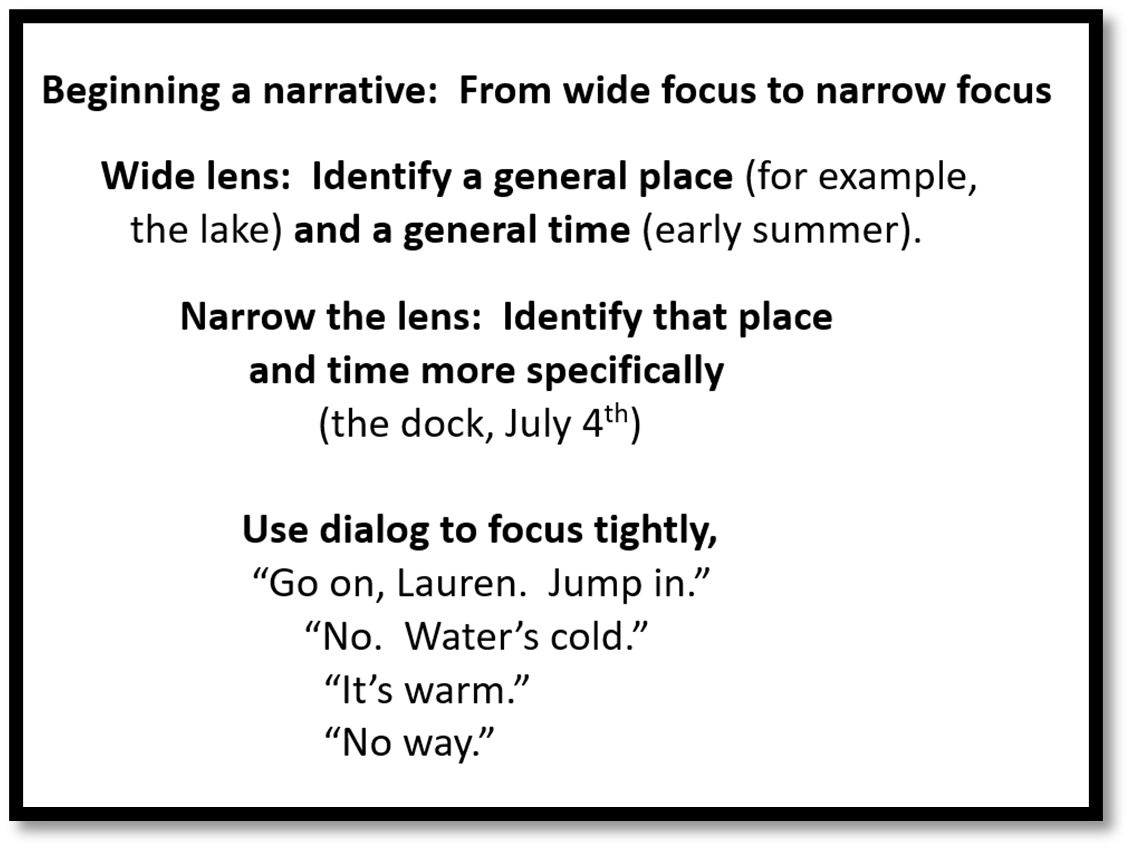
Start* with a wide view lens, farther back in time, such as
- “I graduated from New Haven in 1915, just a quarter century after my father, and a little later I participated in that delayed Teutonic migration known at the Great War.” From this beginning, we learn the narrator is a young man (Yale was a men-only university in 1915), a WWI vet (a participant in WWI) , and from a moneyed family (Most Americans could not afford college, yet alone Yale University in the early 20th century).
Now change that wide-angle lens to a normal lens, narrowing in on place and time.
- “I came back restless. . . .so I decided to go east and learn the bond business. . . .in the spring of twenty-two. (Uncertain about his future, the young man settles on selling bonds on the East Coast.)
Lastly zoom in, using conversation to learn about a character or setting.
- “What you doing, Nick?” (We know his name.)
- “I’m a bond man.” (He has secured a job selling bonds.)
- “Who with?”
- I told him. (The name of the firm is not important to us.)
- “Never heard of them.” (The firm is little known or the speaker disparages that line of work)
- This annoyed me. (Nick feels put down.)*
This type opening–starting with a wide angle lens, telescoping in to a regular lens, and then focusing on specific dialog–gives you a pattern to follow, a pattern with a proven record of success. Look for this pattern, likely spread out over several paragraphs.
*From The Great Gatsby by F. Scott Fitzgerald

 English Writing Teacher