Monthly Archives: July 2019

What’s an action verb? What’s an active voice verb? Are they they same?

A reader said she is confused about active voice verbs and action verbs.  Are they the same?

Sometimes.

Let’s start with action verbs.  In English there are three kinds of verbs:  action verbs, linking verbs and state of being verbs.

  • In a sentence with an action verb, some kind of action is stated or implied by the verb. Some examples are “Ani ate dinner.”  “Lizzy considered her options.”  “The plan worked.”
  • In a sentence with a linking verb, the subject is linked to a noun, a pronoun or an adjective which comes after the verb. Often the verb is a form of the verb “to be” but it can be other verbs replaceable by the verb “to be.”  Some examples are “My dog felt [was] hot.”  “The tests sound [are] hard.”  “That man is my father.”
  • In a sentence with a state of being verb, the existence of something is noted. Sometimes a form of the verb “to be” is used, but not always.  For example, “Washington, D.C. is in the US.”  “Yes, Grandma and Grandpa are at home today.”  “Jefferson lives.”—words attributed to John Adams on his deathbed.

Some action verbs are active voice verbs, and some are passive voice verbs.  Linking verbs and state of being verbs cannot be made into passive verbs.

  • In a sentence with an active voice verb, the subject does the verb. For example, “Davis eats an apple.”  “The dog had barked for hours.”  “The treaty did not solve the problems.”
  • In a sentence with a passive verb, the subject does not do the verb. The object of the subject does the verb.  Sometimes the object / actor is named, but sometimes the object / actor is not named.  For example, “The assignments were completed.”  [By whom?  We don’t know.]  “An apple is being eaten.”  [By whom?  We don’t know.]   “The medal was won by the Swedes.”  [By whom?  The Swedes.]

So to recap, action verbs can be either active voice (when the subject does the verb) or passive voice (when someone other than the subject does the verb).  Linking and state of being verbs are neither active voice nor passive voice.

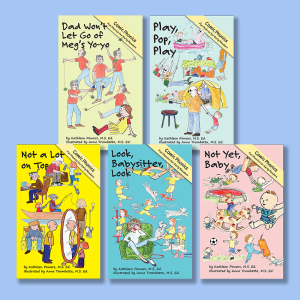
Fun picture books for beginning readers, plus learning activities

Are you looking for funny stories for your beginning reader? Silly stories using easy-to-read CVC and sight words?  With silly pictures to make kids laugh? And learning activities to reinforce the phonics?

We’ve made them!

Click on the image above for more information on these beginning readers.

Years ago, when my kids were learning to read, that’s what I wanted. But I couldn’t find them. So I started writing them. My sister, an art teacher, made them even funnier with her cartoon-like drawings. We tried them out on our kids and later my students, improved them, and now they are available for you to use with your beginning readers.

The story themes focus on little kids’ lives.

• A six-year-old receives a yo-yo for her birthday, but her father wants to play with it.

• A baby brother wants to do what his kindergarten-age brother does, but he’s too little.

• A wild child makes a mess while the babysitter gabs on the phone.

• A preschooler talks his grandfather into playing with his toys.

• A five-year-old devises ways to hide her father’s bald head.

After each story are several pages of game-like learning activities to reinforce the words and ideas of the stories.

My sister, Anne Trombetta, the illustrator, and I, the author, are teachers with masters’ degrees. We’ve applied educational research to devise story lines, words, activities and art to engage new readers.

Please check out our early reader picture books. We hope you’ll not only buy  them, but tell us how your little reader responded to the silly stories.

12 reasons to write using a pen name

Have you ever thought of writing under a pen name / pseudonym / nom de plume?

You might think that pen names are an obsolete notion, or that only people who have something to hide would write under a pen name.  But that’s not true.  There are many good reasons to write under a name different from your own.  For example,

  • Your name is difficult to pronounce.
  • Your name is difficult to spell.
  • Your name sounds too young or too old for your target audience.
  • Your name doesn’t fit with your genre of writing.
  • Your name sounds too ethnic or not ethnic enough.
  • Your name brings to mind the wrong image.
  • Your name, or one like it, is already taken by another writer.
  • You need to disguise your identity.
  • “You” are really two or three authors working together.
  • Your name sounds a lot like another author’s name in your genre.
  • You want a website or URL under your published name, but that website name or URL is taken, is difficult to remember, or is difficult to spell.
  • You want a name which creates better marketing opportunities.

If you are a teacher looking for a writing topic for your students, here is one.  After you explain what a pen name is, and why a person might choose one, ask the students to create pen names for themselves.  Then ask them to write about the pen name.  For younger students, the writing might be a paragraph, but for older students, this assignment could be an essay explaining why they are choosing to write under a pen name and why they chose the pen name they did.  You could collect the assignments and read them aloud, letting the students  decide who really wrote the essay.

Next:  Some famous pen names