Monthly Archives: April 2015

Should students illustrate their writing with drawings (like in the Wimpy Kid)?

Many of my students do. And here’s why.

  • Illustrating encourages students to write. The drawings become the carrot that entices the students to write words.
  • Information gleaned from the drawings can later be added as details to the writing during revisions. Some students add few details in their writing but add rich details in their illustrations. A teacher can encourage the student to transfer some of the visual details into words.
  • The internet has changed the language we use to communicate to a much more visual and less textual language.  Students live more and more in a visually designed online world, using icons, videos, tables, photos and cartoons. Why not let their school work reflect their real world?
  • Drawings can be an icebreaker between a teacher and a poor student writer. “Wow, Adam, I love the way you drew the expression on that guy’s face. Your art is really well done! Now let’s see how we can get that feeling into words.”
  • When students read one another’s work, they love the illustrations. Students may be more willing to accept peer criticism of their writing if they receive peer praise for their drawings.

Below is a narrative with illustrations made by a fifth grader.  The illustrations were in his first draft on notebook paper, but we added them to his final draft.  Click on the graphic below to enlarge it.

Illustrated narrative by a 5th Grader.

Use pictures as prewriting organizers for kids who can’t read yet

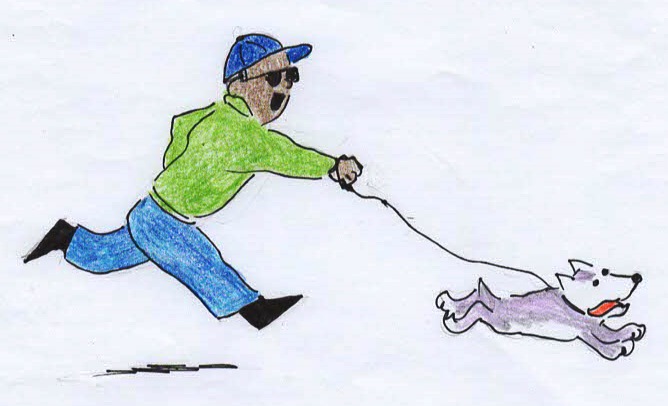
dog barking; wants man to go for a walkOrganizing their thoughts is something good writers do before they write their first sentences. But little kids who are learning to read (or ESL students without much English background) might not be ready for for mindwebs, timelines, comparison/contrast charts or Venn diagrams. What kind of prewriting organizers work for them?

dog brings man leashOne kind I have found effective is a group of drawings about a subject which can be sequenced into a meaningful order to tell a story.

For example, suppose you would like your child to write the story of Little Red Riding Hood.

  • First, read the fairy tale to her to reacquaint her with the details.

man runs with dog

  • Second, find a six-panel cartoon describing the story of Little Red Riding Hood. If the child is really new to writing, you might start with three panels which tell a story and work up to six. Cut out the six panels, shuffle them, and lay them in front of the young writer.

dog is exhausted

  • Encourage the child to put the cartoons in the correct order, discussing why one panel goes before or after another if she seems hesitant.
  • Explain to her that she is going to write down the story of Little Red Riding Hood in the correct order, according to the panels.
  • Capitalization mistakes, missing punctuation, spelling errors, verb tense inconsistencies—ignore them and focus on the storyline. When the child is learning, accept her invented spelling and grammar.
  • If there are three panels, you might expect the child to write three sentences. If there are six, she should be encouraged to write six or more.
  • Often beginning writers forget to use transitions. You might suggest words like “then,” “next,” “a little later” and “suddenly” to smooth out the sequencing of events.
  • Publishing is important too. Hang the finished piece on the refrigerator. Scan it into the printer and email it to Grandma. Print a copy to show the child’s teacher.

Where can you find drawings which tell a story and are suitable for sequencing?

  • Search online. I found some immediately when I looked.
  • Photocopy pictures from a story the child likes and let her sort them into the correct order.
  • Photocopy pictures from a wordless picture book from the library.
  • Goodwill sells dozens of children’s books every day that could be cut up for this purpose.
  • Use family photos. If there was a special event recently, and you have photos of what happened, the child could sort them into a meaningful order.

For some children, writing begins before reading. There is no reason to wait until the child is an adept reader before encouraging her to write.

Use the word “said” instead of one of its many synonyms

Using the most specific vocabulary word usually is good advice in writing, but there is one exception: the word “said.”

Told, stated, remarked, revealed, whispered, shouted, spoke—the list of substitutes is practically endless. But most of the time, “said” is the best option.

When you write, “He said,” you are informing that a person spoke, but you are not informing how he spoke, so the focus goes on the words he said aloud. In the sentence, “Jack said, ‘I am soaking wet from that rain,’” the focus is on what Jack said aloud, as it should be. In the sentence, “Jack hollered, ‘I am soaking wet from that rain,’” the focus is split. Part of the focus is on what words Jack said aloud, and part is on his manner of speech—a holler.

We are so used to reading the word “said” that it virtually disappears, much like the article, “a.” That is what we want. We need to let our readers know who is speaking, but usually the manner of speech is not important. By using any word other than “said,” attention is drawn away from what is said to how it is said, which we don’t want.

A good rule of thumb is to use “said” if you want your reader to focus on the words which were said aloud. However, if you want your reader to focus on the manner of speaking, then use another word. But do so sparingly.  Click on the listing (graphic) below for a larger version.

synonyms for said

Synonyms for the word “said” as compiled by http://www.synonyms-antonyms.com

Writing poems can be family friendly

When I was in school—elementary school, high school, college and graduate school—not once was I taught how to write a poem. I suspect, with hindsight, that my teachers weren’t taught how either, so they couldn’t pass along to me what they didn’t know.

That didn’t stop them from assigning me to write poetry though. As a fifth grader, I remember sitting in front of a blank paper for what seemed like hours not knowing where to begin.

Years later, when my son came home from fourth grade with the assignment to write a poem a night for a week—with no instruction—he had that deer-in-headlights look I knew so well. “We’ll do it together—the whole family,” I told him before he could panic. “You’ll help, won’t you?” I asked his little sister and brother. Everyone was on board, though none of us knew where we were heading.

We chose the kids’ father as the topic for the poem since he was out of town on business that week. We talked about his characteristics—a hummer, a tickler, and a teaser. My son threw out the first line—“One father for sale”—and we laughed. “Write that down,” I said. I think it was my daughter (a second grader) who came up with the dime, nickel, penny follow through. My contribution was ending one line in the middle of a thought and continuing it on the next line. “You can do that?” asked my son. We learned as we went along. My son contrived the last two lines not because they fit but because he wanted the end to rhyme. That was fine with the rest of us.

And from such humble beginnings came this masterpiece:

One father for sale,
One father for sale.
One teasing, squeezing, father for sale.
Do I hear a dime?
He hums all the time.
Do I hear a nickel?
How that man can tickle!
Do I hear a penny?
Oh! I don’t hear any offers
For my teasing, squeezing father for sale.
What can I do?
This isn’t fair.
Dad, sit in a corner
And play solitaire.

My son stood up in class the next day and read his poem aloud to wild applause. That night he took out paper and pencil and led the rest of us in writing about a cat with fleas. “My friends can’t wait to hear what I write,” he said, grinning. Here is that opus.

My cat has fleas
Teensy, weensy, little fleas.
In the dark they bite at me,
My toes, my ankles, and my knees.
I know because I scratch.
One of these days I’ll catch
Those fleas, but ‘til then,
Pass the ointment, please.

From this experience I learned that writing poetry is not the daunting task I had feared as a child. When done with family or friends, it is silliness, laughter, and problem solving too.

April is National Poetry Month. I recommend, if you are lucky enough to have children at home, that you write some zany poems together. To warm up, read some Dr. Seuss or Shel Silverstein. Then pick a topic—the funnier the better.