Monthly Archives: February 2015

How to edit an essay

Because my students’ first drafts are so messy, I sometimes ask them to rewrite them during the revising stage. Many students make clean drafts without my encouragement since they have no room left for changes or since they can hardly decipher their changes any more.

I have learned that when students try to edit using a sloppy, revised draft with cross-outs and insertions, they miss errors.  Even though they have skipped lines to leave room for changes, and have left margins so there is room for insertions, sometimes they need to write a clean draft or type and print  a clean draft for editing purposes.

student essay to be edited

This portion of a fifth grade student essay has been revised but is difficult to edit because of all the cross-outs, circles and insertions. A clean draft would help the student to edit well.

Once they have a clean almost-final draft, students edit. They read every word of their essays, looking for errors such as in spelling, capitalization, verb tenses, plurals, parallel structure, subject-verb agreement, pronoun antecedent agreement, possessive nouns, its and it’s; they’re, there, and their; to, two, and too; and punctuation. Students who overuse certain words (and, then, so, and just, for example) hunt for them and either eliminate them or replace them.

One trick I learned long ago when I was a copy editor is to read each sentence out of order, starting with the last sentence and ending with the first sentence. By listening to sentences out of order, mistakes are easier to hear. My students think this technique is silly until they try it, but then they realize its usefulness. Usually I wait until a student is in middle school to suggest this editing technique.

As students edit, I try to read along with them, to suggest grammar and usage problems they might not suspect. At this point I sometimes teach a grammar lesson on the particular problem the student has encountered, especially if this problem is recurring.

When the student finishes editing his final hand-written copy, the student or I type this draft on the computer, leaving any remaining errors as they are. At our next meeting, the student edits for a second time, usually finding a handful of errors he missed during the first edit. (It’s so much easier to find errors when the writing is printed rather than hand-written.) Sometimes the student will make significant changes at this point, but not usually. Since I am aware of what the errors are, I point out errors that the student has not found.

Next we’ll talk about the value of typing and printing a final version of a student’s essay.

Clueless student writers benefit from a fill-in-the-blanks book report form

Although a specific prewriting organizer for a book review (see last week’s blog) is sufficient help for some writers to get going, for other students, this is not enough. “Yeah, but how do I begin?” they ask after they have filled in the boxes of the organizer.

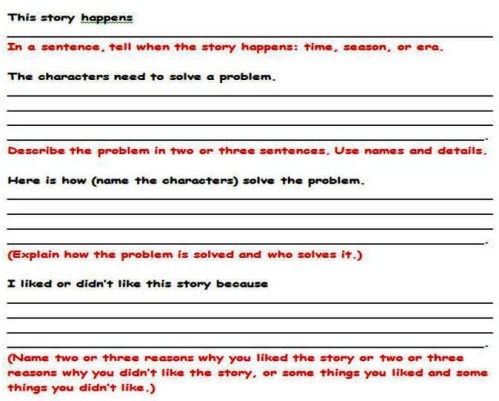
For them, I use a fill-in-the-blanks book review. It looks like this:
Form fill-in-the-blanks book report


Form fill-in-the-blanks book report
When students have filled in the blanks I ask the students to read the black typed parts and their own words aloud, listening for mistakes. Together we correct the mistakes.

Then I either accept the book review as is, or I ask the students to rewrite it on a different sheet of paper, using the black typed parts and their own words but leaving out the red directions. Rewriting the fill-in-the-blanks sheet strengthens the features of a book review in the students’ minds so I see this as a useful task. Plus it prepares the student for revising in the future.

A fill-in-the-blanks book review form is a crutch for primary school students and ESL students who don’t know what is expected in a book report. After students use it a few times and become comfortable with its features, I ask them to look at it while they write their reviews, but to write their reviews on a different sheet of paper. Eventually, as they become more confident writers, they no longer need it.

How to help clueless children organize a fiction book review

Some children are truly clueless when it comes to writing and can benefit from step-by-step directions. If they use the same directions several times with different prompts, they begin to pick up patterns they can use in much of their writing. Here is how I approach a book review assignment for such children.

  • First, I hand out a blank prewriting organizer that I designed. (See below.) On it are important categories that should be mentioned in a book review.

prewriting organizer book review

  •  I ask the student to write down the name of the book. “Look at the cover,” I tell him, “and write it down exactly that way.” Then he writes down the author’s name. Sometimes I ask the student to go to the title page if the cover is confusing. There the information is clear.  If there is an illustrator, I have the student add the artist’s name.
  • Next, I ask where the book takes place. I probe until the student gives a detailed answer. He might start out saying something vague like “near a volcano,” but with help, he will say “in Pompeii, a city near a volcano called Mt. Vesuvius in Italy.” I ask him to write down the specific details on the prewriting organizer.
  • When did the story take place? The student might say something like “once upon a time.” We discuss if the events really happened or if they are make-believe. I probe, trying to get the student to supply a date, or a time period, or a certain number of years ago. If necessary, we page through the book together to find the information, and he might write “about 2,000 years ago.”
  • Who are the important characters? This information is usually easy for the student to supply, but some students have trouble distinguishing between important characters and minor characters. We discuss those ideas if this is confusing for the student. He might write down “Annie and Jack.”
  • What problem do the characters face? Huh? The student might have no idea if he is not used to thinking about a book this way. I explain that in all fiction books the main character(s) needs to do something: find out where a missing cat is, discover that her new baby brother is not a monkey after all, or stay safe from the big, bad wolf. Together we talk about what the problem in the book is, and the student writes it down.
  • How do the characters solve the problem? Again, the student might not be aware that at the end of most novels, the character solves the problem he or she faced throughout the novel. How does Cinderella meet the prince again and marry him? How does Sylvester return home to his family? How does Junie B. get home without taking the school bus? The student writes down the solution on the prewriting organizer.
  • Last, we talk about what the student liked or didn’t like about the book. If he just shrugs, I go back to the ideas we have already discussed—the setting, the characters, the problem and the solution. Did you care about any of them? Usually he cares about something, and we write that down. If there are illustrations, we talk about those. We talk about the vocabulary—too easy, too hard, or just right? Was the book funny? Eventually we come up with three or four ideas about why he liked or didn’t like the book.

This prewriting organizer worksheet and my help force students to think about the setting, characters, problem, outcome and likes/dislikes before they write the first sentence of their book reviews (which is, of course, what good writers do).

However, even with this preparation, some students still struggle with how to write that first sentence and how to sequence the rest of the information. We’ll talk about an even more specific strategy to get them started next time.

(The worksheet used here is my adaptation of one created 30 years ago by K. Wood. More about that can be found in Wood, K. D. (1984). Probable passages: A writing strategy. The Reading Teacher, 37(5), 496-499.)