
What do the Common Core Standards in writing require of typical students? What skills do students need to master using these new guidelines?
To give you an idea, I chose a state—Washington—at the opposite end of the country from where I live—Georgia—to see what its Department of Education expects. I chose to look only at the writing standards which apply to fifth graders.
Here is what I found.
Washington decided on four “Essential Academic Learning Requirements for Writing (2005).” (I have color-coded the four essential requirements so that you can follow them more easily.) They are
- EALR 1: The student understands and uses a writing process.
- EALR 2: The student writes in a variety of forms for different audiences and purposes.
- EALR 3: The student writes clearly and effectively.
- EALR 4: The student analyzes and evaluates the effectiveness of written work.
From these for essential requirements educators and parents in Washington derived much more detailed learning expectations. They are listed below. Although these learning expectations are unique to Washington, they resemble what is happening in other states which have adopted the Common Core Standards.
Component 1.1: Prewrites to generate ideas and plan writing.
1.1.1 Applies more than one strategy for generating ideas and planning writing.
- Generates ideas prior to organizing them and adjusts prewriting strategies accordingly (e.g., brainstorms a list, selects relevant ideas/details to include in piece of writing, uses a story board).
- Gathers information from a range of sources, formulates questions, and uses an organizer (e.g., electronic graphic organizer, chart) to analyze and/or synthesize to plan writing.
1.2.1 Produces multiple drafts.
- Refers to a prewriting plan.
- Drafts by hand and/or electronically.
- Rereads text and continues drafting over time.
- Rereads text, puts it away, and returns to it later.
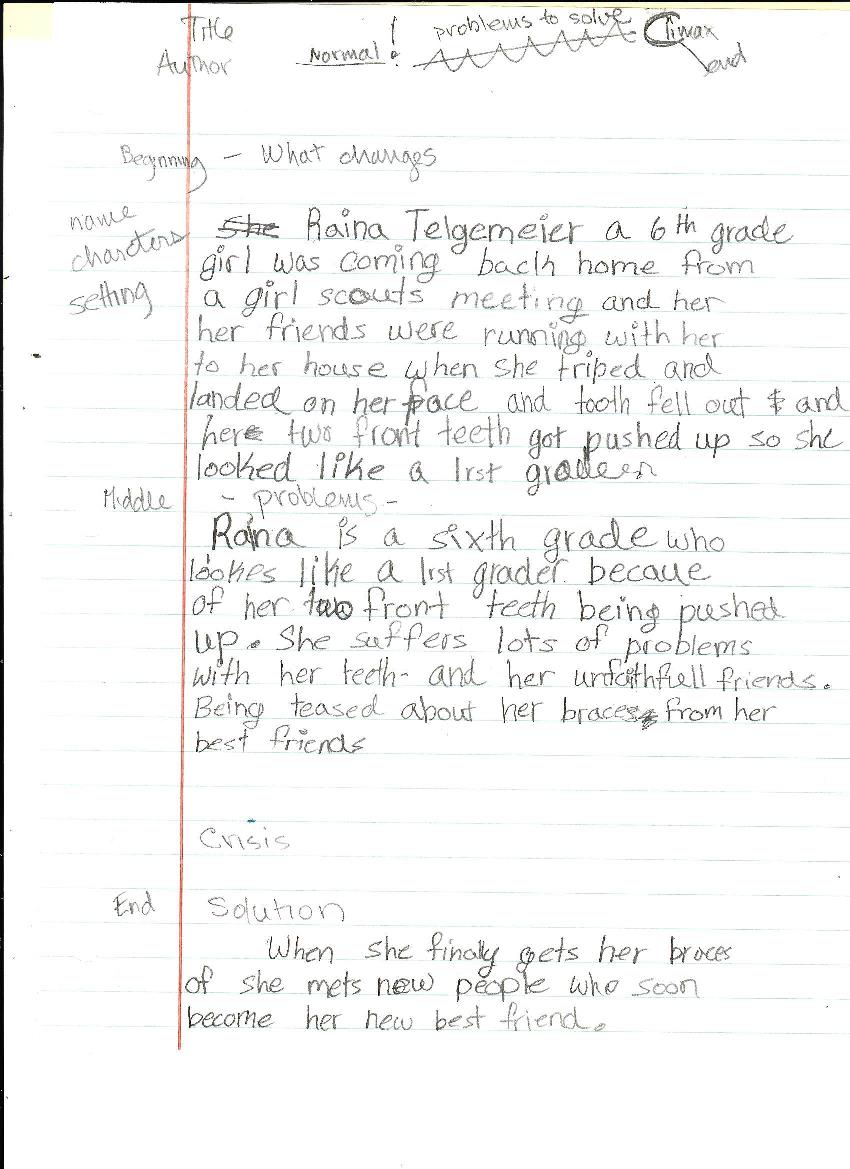
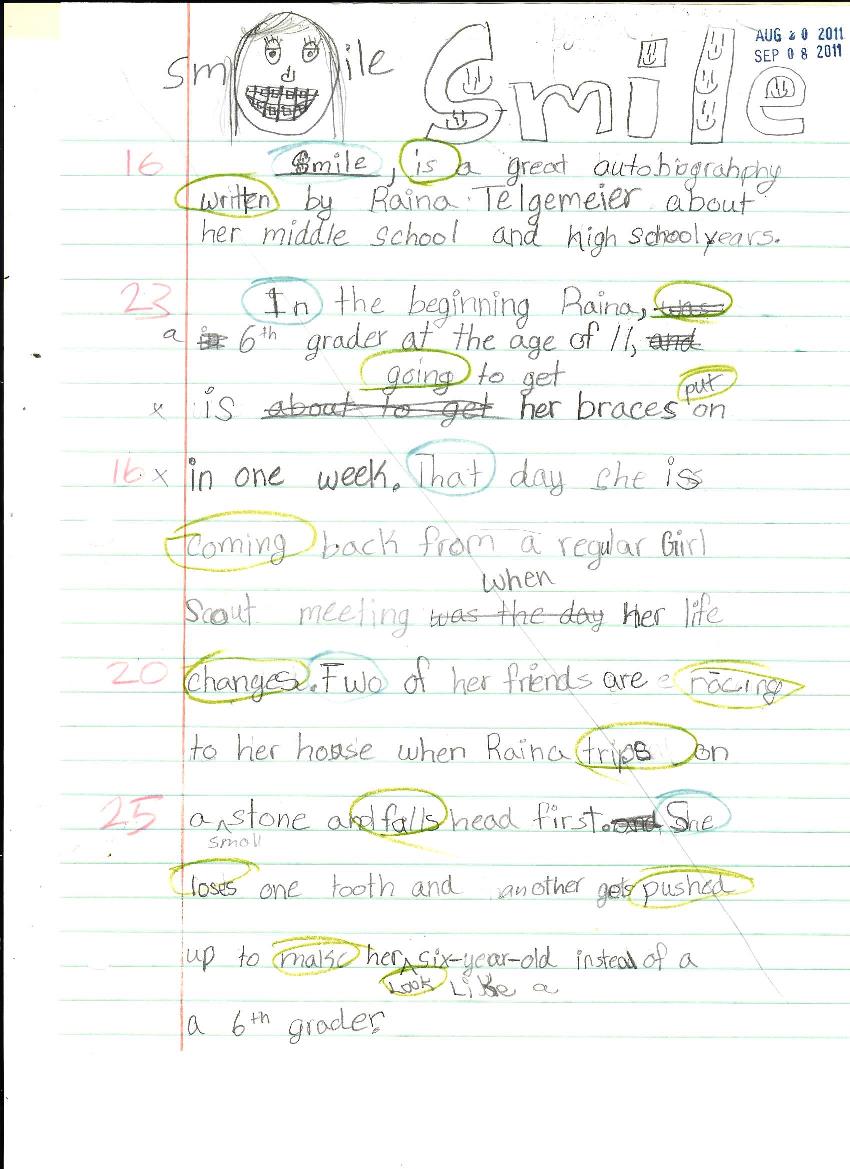
1.3.1 Revises text, including changing words, sentences, paragraphs, and ideas.
- Rereads work several times and has a different focus for each reading (e.g., first reading — adding details for elaboration; second reading — deleting sentences or phrases to achieve paragraph unity; third reading — reorganizing ideas for meaning).
- Records feedback using writing group procedure (e.g., partner underlines telling sentences, such as “I had fun,” and writer changes to show detail, “I squealed as the roller coaster sped around a corner.”).
- Makes decisions about writing based on feedback (e.g., revision before final draft).
- Uses multiple resources to identify needed changes (e.g., writing guide, peer, adult, computer, thesaurus).
1.4.1 Applies understanding of editing appropriate for grade level (see 3.3).
- Identifies and corrects errors in grade level conventions.
- Uses multiple resources regularly (e.g., dictionary, peer, adult, available technology, writing guide).
- Proofreads final draft for errors.
1.5.1 Publishes in more than one format for specific audiences and purposes.
- Publishes using a variety of publishing options (e.g., book, poster).
- Publishes multipage pieces and attends to format, graphics, illustrations, and other text features (e.g., captioned photos, maps).
- Publishes for a wide range of purposes, in different forms and formats.
- Uses a variety of available technology as part of publication (e.g., slide show, overhead projector, publication software).
1.6.1 Applies understanding of the recursive nature of writing process.
- Revises at any stage of process.
- Edits as needed at any stage.
1.6.2 Uses collaborative skills to adapt writing process.
- Contributes to different parts of writing process when working on a class poetry book (e.g., individuals draft poem; group plans format together; individuals submit word processed poems; team edits; class publishes).
1.6.3 Uses knowledge of time constraints to adjust writing process.
- Works on one draft over several days or weeks adjusting work to fit the time frame.
- Allots amount of time for each stage of writing process for on-demand writing.
- Adjusts the number of drafts for on-demand tasks.
Component 2.1: Adapts writing for a variety of audiences.
2.1.1 Applies understanding of multiple and varied audiences to write effectively.
- Identifies an intended audience.
- Identifies and includes information a diverse audience needs to know (e.g., explains prior events, makes no assumptions about audience’s prior knowledge, such as defining an ollie in skateboarding).
- Anticipates readers’ questions and writes accordingly.
2.2.1 Demonstrates understanding of different purposes for writing.
- Writes to analyze informational text or data (e.g., explains the steps of a scientific investigation).
- Writes to learn (e.g., math learning logs, reflections, double-entry logs, steps/strategies used to solve math problems), to tell a story, to explain, and to persuade.
- Writes for more than one purpose using the same form (e.g., a letter used to explain, to request, or to persuade).
- Includes more than one mode within a piece to address purpose (e.g., descriptive details or narrative anecdote within an explanation.
2.3.1 Uses a variety of forms/genres.
- Includes more than one form/genre in a single piece (e.g., a report about salmon that includes a poem, fact box, and story).
- Maintains a log or portfolio to track variety of forms/genres used.
- Produces a variety of new forms/genres. Examples:
~ interviews
~ autobiographies
~ business letters
~ expository essays
~ persuasive advertisements
~ field observation notes
~ book reviews
~ rhyming couplets
~ raps
2.4.1 Produces documents used in a career setting.
- Collaborates with peers on writing projects (e.g., social studies reports, science lab reports).
- Writes in forms associated with specific tasks or careers (e.g., fund-raising receipts, student council applications, data collection forms).
Component 3.1: Develops ideas and organizes writing.
3.1.1 Analyzes ideas, selects a narrow topic, and elaborates using specific details and/or examples.
- Narrows topic with controlling idea (e.g., from general topic, such as baseball, to specific topic, such as “The Mariners are my favorite baseball team.”).
- Selects details relevant to the topic to extend ideas and develop elaboration (e.g., specific words and phrases, reasons, anecdotes, facts, descriptions, examples).
- Uses personal experiences, observations, and research to support opinions and ideas (e.g., data relevant to the topic to support conclusions in math, science, or social studies; appropriate anecdotes to explain or persuade).
- Varies leads and endings in narratives.
- Sequences ideas and uses transitional words and phrases to link events, reasons, facts, and opinions within and between paragraphs (e.g., order of importance — least, most).
- Organizes clearly:
~ comparisons (e.g., point-by-point)
~ explanations (e.g., save most important point for last)
~ persuasion (e.g., if-then)
~ narratives (e.g., problem-solution-outcome).
3.1.2 Uses an effective organizational structure.
- Writes in a logically organized progression of unified paragraphs.
- Develops an interesting introduction in expository writing (e.g., leads with the five W’s, an interesting fact).
- Develops an effective ending that goes beyond a repetition of the introduction (e.g., summary, prediction).
- Varies leads and endings in narratives.
- Sequences ideas and uses transitional words and phrases to link events, reasons, facts, and opinions within and between paragraphs (e.g., order of importance — least, most).
- Organizes clearly:
~ comparisons (e.g., point-by-point)
~ explanations (e.g., save most important point for last)
~ persuasion (e.g., if-then)
~ narratives (e.g., problem-solution-outcome.
3.2.1 Applies understanding that different audiences and purposes affect writer’s voice.
- Writes with a clearly defined voice appropriate to audience (e.g., informal versus formal voice).
- Writes in appropriate and consistent voice in narrative, informational, and persuasive writing (e.g., a “how to” paper vs. a persuasive piece).
3.2.2 Uses language appropriate for a specific audience and purpose.
- Uses precise language (e.g., powerful verbs, specific descriptors).
- Uses formal, informal, and specialized language (e.g., photosynthesis, ratio, expedition) appropriate for audience and purpose.
- Uses literary and sound devices (e.g., similes, personification, rhythm). • Selects words for effect.
3.2.3 Uses a variety of sentences.
- Writes a variety of sentence lengths.
- Writes a variety of sentence beginnings (e.g., starts with a participial phrase: “Laughing loudly, they walked down the hall.”).
- Writes a variety of sentence structures (e.g., “Tran, busy with his homework, didn’t hear the telephone at first. Although he wanted to keep working, Tran took the call. He kept it short.”).
- Writes with a rhythm pattern.
3.3.1 Uses legible handwriting.
- • Maintains consistency in printing or cursive handwriting (e.g., size, spacing, formation, uppercase and lowercase).
3.2.2 Spells words appropriate for the grade level accurately.
- Uses spelling rules and patterns from previous grades.
- Spells high-frequency words correctly.
- Uses multiple strategies to spell. Examples:
~ Visual patterns (e.g., -ion endings)
~ Sound patterns (e.g., easily confused endings -able / -ible, -ant /-ent)
~ Affixes (e.g., pre-, in-, un-, -ed, -ing, -graph)
~ Rules (e.g., “i” before “e” rule).
- Self-corrects spelling errors.
- Develops a personal spelling list.
- Uses resources to find correct spelling for words identified as misspelled.
3.3.3 Applies capitalization rules.
- Uses capitalization rules from previous grades.
- Capitalizes brand names (e.g., Nike).
- Capitalizes geographic regions (e.g., the West).
- Uses resources.
3.3.4 Applies punctuation rules.
- Uses punctuation rules from previous grades.
- Uses periods in abbreviations (e.g., pg., ft.).
- Uses commas to set off interjections (e.g., Okay, if you say so.) or
explanatory phrases (e.g., They stood together, away from the pile of stones in the corner, and their voices were quiet.).
- Uses comma after date or address within text (e.g., June 1, 1993, was an important day in my life.).
- Uses quotation marks in dialogue correctly (e.g., “How’s it going?” the boy asked.).
- Uses hyphen in numbers (e.g., twenty-three).
- Uses hyphen to join numbers (e.g., pages 1-3, The Mariners won, 17-6.).
- Uses ellipsis ( . . . ) correctly:
~ to show omitted words
~ to show a pause.
- Uses semicolon correctly between two independent clauses.
- Uses resources to check punctuation.
3.3.5. Applies usage rules.
- Applies usage rules from previous grades.
- Uses subject vs. object pronouns correctly (e.g., I vs. me).
- Uses resources to check usage.
3.3.6 Uses complete sentences in writing.
- • May use fragments in dialogue as appropriate.
3.3.7 Applies paragraph conventions.
- Uses paragraph conventions (e.g., designated by indentation or block format, skipping lines between paragraphs).
- Uses new paragraphs to change speakers in dialogue.
3.3.8 Applies conventional forms for citations.
- Cites sources in research using a bibliographic format.
Component 4.1: Analyzes and evaluates others’ and own writing.
4.1.1 Analyzes and evaluates writing using established criteria.
- Identifies professional authors’ styles and techniques (e.g., leads,
conclusions, word choice, purpose, character, and plot development).
- Critiques peers’ writing and supports the opinion using established criteria (e.g., content, organization, style, conventions).
- Explains accuracy of content and vocabulary for specific curricular areas (e.g., in science — looking for conclusions drawn from data).
4. 1.2 Analyzes and evaluates own writing using established criteria.
- Explains strengths and weaknesses of own writing using criteria (e.g., WASL rubric and anchor papers, checklists, 6-trait scoring guides).
- Uses criteria to choose and defend choices for a writing portfolio.
- Provides evidence that goals have been met (e.g., “My sentence fluency has
improved because I now vary the beginnings of my sentences.”
4.2.1 Evaluates and adjusts writing goals using criteria.
- Writes reflection about growth in writing and creates an improvement plan (e.g., “My introductions are getting better, but I need to learn about different kinds of conclusions.”).
- Evaluates own use of writing process and sets goals (e.g., “After I brain-storm, I need to organize my ideas so my writing flows in a logical order.”).
- Maintains a written log of goals.
Realistic goals? Remember this is one part–writing–of one course–English Language Arts–for fifth graders. We’ll know more in June when the first class of Washington’s fifth graders completes this curriculum.




 English Writing Teacher