Monthly Archives: September 2014

Sentence beginnings should vary

Here is how many younger children write:

Today I woke up and ate breakfast.  Then I got on the school bus with my friend, Anya.  I sat near the window.  I put my backpack on a hook and I sat down.  I did my morning work first, and then I said the pledge.  I did math until it was time to go to specials. 

Do you notice that almost every sentence begins with “I,” and the two sentences that begin with another word use “I” as the second word?  What is the effect?  Boring.

Yet this is how beginning writers start their sentences.  Their world is “I” focused, and so is their writing.  As they grow older, this tendency wanes, but repeating the same word at the beginnings of many sentences continues.

Revising general wording to more expressive wording.

An excerpt of a third grader’s essay with his revisions.

Here’s how I break students of this habit.  First, I ask the students to circle the first word of every sentence, using a color quite different from the color they used to encircle verbs.  That is so the first words stand out.

Next, the students read the words aloud and listen for repetition.  Almost always they find it.

For new students, I offer suggestions on how to vary sentence openings.  This is a skill older students learn quickly, so after the first few lessons, they can work independently on future writing.  What are some easy yet effective ways to improve sentence openings?

  • Many sentences begin with a pronoun like “he” or “she.” I suggest using the person’s name if it hasn’t been used, or repeating the person’s name.  If it has been used as a sentence opening in a nearby sentence, I suggest using a relationship, such as “My mother” or “My music teacher.”
  • Sometimes there is a prepositional phrase later in the sentence which could easily be moved to the front of the sentence. “I went to school in the morning” could be changed to “In the morning I went to school.”
  • An adverb can often be added to the front of a sentence unless this technique is overused by the student. I help students find a less common adverb, such as “later” rather than “next” or “then.”
  • Sometimes consecutive sentences can be combined to eliminate a repetitive opening word. “I did my morning work first, and then I said the pledge.  I did math until it was time to go to specials” can be replaced with “I did my morning work, said the pledge, did math and then went to specials.”
  • Sometimes writing a new sentence beginning is what works best.

Next we will talk about changing parts of speech at the beginnings of sentences.

How to replace is, are, am, was, were, be, been and to be.

The hardest skill students learn is how to replace the verb “to be.”  Yet is it the single most important skill for improving the verbs in their writing.

The problem is that the verb “to be” rarely has strong synonyms.
As a linking verb it can sometimes be replaced with another linking verb.  “He is sick” can become “He looks sick” or “He feels sick” or “He seems sick.”  But none of those replacements is much stronger than the original verb, “is.”

Change common verbs to more expressive verbs.

An excerpt of a third grader’s revised essay.

Even harder is when the verb identifies something that exists.  How do you restate, “That dog is mine.”  “That dog was mine,” changes just the verb tense; it is the same verb.  “That dog becomes mine,” changes the meaning.

What I tell my students is that usually they will need to replace not just the verb, but the whole sentence.  I ask them to tell me what the sentence means, using other words.  For the sentence, “He is sick,” I ask how they know he is sick.  What does he look like that would let me know he is sick?  They might say, “His face is red and he has a fever.”  I might say, “That’s good, but you are still using the word is.  How can you tell me that his face is red and that he has a fever without using the word ‘is’”?  Usually they are stumped, so I offer suggestions.  “His mother placed an ice bag on his flushed forehead.”  Or, “’Wow!  101 degrees,’ said his mother shaking the thermometer.”   Or, “The feverish boy lay down on the cold tile floor, moving every few seconds to chill his hot body.”

The trick is to let the reader see, hear, touch, smell or taste (usually see) what the writer saw in his mind before he wrote, “He is sick.”  “He is sick” is a conclusion based on certain facts.  What are the facts that led the writer to conclude that “He is sick”? Those facts are what the reader needs to know so that the reader can come to his own conclusion that “He is sick.”

We’ll have more blogs on changing the verb “to be” in the future because it is such a vital part of improving writing, yet such a difficult skill to master.  For now, we’ll move on to the next blog about sentence beginnings.

How to replace weak verbs with strong ones

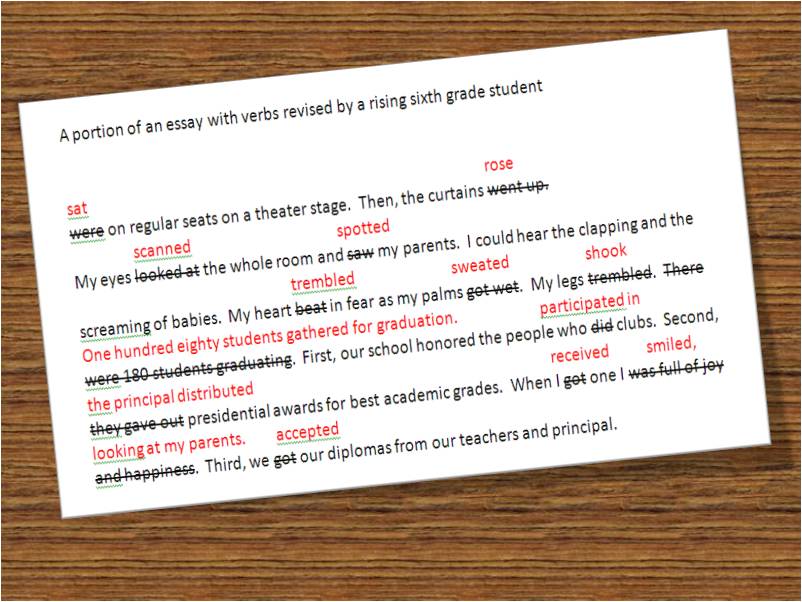
Excerpt from a student's paper showing revised verbs.

Click on the picture for an enlarged version.

Replacing weak verbs with strong, specific ones is the key to good writing.  When new writing students begin with me, I work one-on-one with the students on this skill over and over to be sure they understand its significance and how to do it.

First, the student identifies the verbs used in the piece of writing, and lists them with tally marks to show how often the student used them.  To revise, we start with some easy words to replace, such as get, go, do, make and take.  The verbs are already encircled with color in the essay, so it is easy to find one of those words.  The student reads the sentence aloud, and I ask if he can think of any word to replace the weak verb.

In the sentence, “I go to JFK Elementary School,” for example, the student ponders the word “go.”  “I take classes in,” he might suggest.  With more prodding he might say, “I study in.”  I might accept that in a third grader, or I might suggest the word “attend” for an older student.  He crosses out the word “go,” and writes “study” or “attend” in the space above the crossed out word.  Then we move on to the next word.

In every revising lesson, I ask the students to use a thesaurus.  Many students have not used a thesaurus (or dictionary) before (except online), so this becomes a mini lesson on how to use those resources.  For the sentence, “I gave the dog a bath,” the student needs to know that a verb is always listed in the present tense, so the word to look up is give, not gave.  I explain that because “give” is so general, there are many meanings listed.  The student cannot pick any one.  He needs to choose a meaning that works for the sentence.  Sometimes we discuss which word works best based on many factors such as the child’s age, his grasp of vocabulary and the degree of formality of the writing.

Rarely does the student replace every weak verb.  Since I am teaching the student a process, nailing each verb is not my goal.  Learning that weak verbs should be replaced, and knowing how to replace them, is.

The hardest verb to replace is the verb “to be.”  We will talk about that in the next blog.

To revise, replace weak or overused verbs with strong, specific verbs.

overused verbs list

When revising, I ask students to encircle each main verb (not helping verbs).  Then, on a separate paper, students make a list of the verbs, using tally marks to show how many times each verb is used.  Usually I help them to write the first list.  Present, past, future—all forms of a verb are treated as the same verb.  Many students are not aware that “is,” “are,” “was,” “were,” “be,” and “been” are the same verb, so I often write those words together at the top of the paper, as well as “have,” “has” and “had”; “do,” “does,” “did;” “go” and “went.”

After the list with its tally marks is complete, I review the first draft, looking for verbs the student has not found.  Younger students sometimes don’t know what verbs are, so this is a learning experience for them.  Older students often miss identifying the verb “to be.”  I encourage independence, but I step in when the student doesn’t know what to do.

With the students looking at their completed list of verbs, I ask, “What do you notice?”  I hope they say something like, “Well, I used an awful lot of get and got, and also is and are.”  The point is for the students to recognize that they have overused some verbs.

How many is too many?  In a typical piece of student writing of two, three or four double spaced pages, three or more uses of the same verb is too many for my purposes, but there are exceptions.

  • I point out that we are stuck with repeating some verbs which haven’t many synonyms. “Play” is such a verb.  How do you say, “I play the piano” or “I play soccer” without using the word play?
  • Other weak verbs should be replaced even if there is only one of them. “Get,” “take,” “make,” “come,” “go,” “have,” and “do” are vague in meaning and can usually be replaced with more specific verbs.
  • When a verb is used as part of an idiom, it can be hard to replace, and I often allow such verbs for younger children. For older kids, I ask if there is another way to say the thought without using an idiom.

Now comes the most important work of revising:  replacing weak verbs with strong ones.  More on that in the next blog.