Monthly Archives: June 2014

The five paragraph essay

I bet 99 out of 100 of my students have been told that every paragraph must contain five sentences, and that every essay must have five paragraphs.  This idea is so indoctrinated by teachers that students fear veering from it.  One of my best writing students composed an essay for which we thought up a single line zinger after the conclusion.  It was perfect—irreverent and definitely humorous.  She wouldn’t use it.  “I wouldn’t have five paragraphs anymore,” she told me.

Five paragraph essay structure.

Click on the graphic to enlarge it.

Why the five paragraph essay, anyway?

    • Formal logic is the tradition upon which essay writing is based, and that tradition goes back to ancient Greece.  In formal logic, premises lead to conclusions.  In five paragraph essays, the topic sentences of the three body paragraphs lead to believing the truth of the thesis, stated in the introduction and repeated in the conclusion.
    • Essay writing began in France in the 1500’s, not as a structure for writing as much as a structure for logical thinking and arguing.  Essays then were not confined to five paragraphs, and their purpose was to persuade with clear thinking.
    • In the 1800’s in the US, essays—then called themes—became increasingly standardized so that they could be reliably assessed.  An introductory paragraph introduces the general idea and ends with a thesis statement which includes the three main points supporting the thesis.   Three body paragraphs each begin with an idea supporting the thesis and then go on to bolster that support.   The last of those three body paragraphs sometimes defeats a counterargument.  The conclusion cements the argument and repeats the main points.
    • Standardized testing took hold in the US in the mid to late 1900’s, and with it came formulas for writing essays that could be easily graded.
    • Today the five paragraph essay dominates in schools, starting in elementary grades and continuing into high school.

But why five paragraphs?  Why not four or six or seven?  I think it is the Western World’s preference for the number three.  Take away the introduction and conclusion and that leaves three body paragraphs for the essay.  Three has long served as an important number in western thinking, starting in the Catholic religion with the Father, Son and Holy Spirit.  The number three is important in many fairy tales such as “Goldilocks and the Three Bears,” “The Three Little Pigs,” and “The Three Billy Goats Gruff.”  Even Abraham Lincoln enshrined the number three with the phrase “of the people, by the people and for the people.”

This approach to essay writing requires that the writers know their thesis (that is, the conclusion of the logical argument) before they begin writing.  As a result, students are taught to brainstorm and to write outlines of their thinking before writing their first drafts.  These prewriting strategies help students to see the scope of the issue (brainstorming) and to narrow it down to its most important arguments (outlining).

Is this five paragraph structure good? 

On the one hand, students have a pattern to follow which limits the number of paragraphs within which to explain their arguments.  It requires conciseness and clarity, two qualities of good writing.

On the other hand, students are forced to conform their thoughts to a somewhat arbitrary pattern.  What if students have three excellent points to make, not two?  What if there are two excellent counterarguments that need to be defeated?  Oh well.

Next we will look at transitions.

Write the first draft skipping lines or double spacing.

Since most of the improvement in writing comes in revising, it is important for students to leave room in their first drafts for revising. For that reason, I recommend that:With a first draft, leave spaces between lines and keep a one inch margin all around.

  • Students should write on every other line of notebook paper if writing by hand, or they should double space if composing on the computer. That additional space between lines allows room to insert changes and still be able to read the text. For students who are not used to skipping lines, I print tiny X’s in the left margin of every other line to remind the students to skip lines. Most students are not used to writing this way, and they forget. If so, let them finish the line they are on and then skip the next line. Once they have revised, they will understand the need for all this white space.
  • Students should write on one side of the paper only. This way, as they start a new page, they can look back at the last few sentences they have written without flipping the paper back and forth. Rereading as they write is important for continuity. It also allows room on the back of the paper for major revisions later on, including adding whole paragraphs. Another plus is that by placing the words just written above and almost touching an empty page of notebook paper, the student does not perceive an empty page, and he finds it easier to pick up the thread.
  • Students should leave one inch margins on each side of notebook paper and on the computer. The margins allow for more revision space and for other kinds of analyzing, which I will explain in a later blog.
  • Students should write darkly so that the writing can be easily read. If they use pen, they should use dark blue or black ink for easy reading and because colored pencils or inks will be used in the revising process.
  • Students should use clear handwriting. If I cannot read a student’s handwriting, I stop the student immediately and ask him to fix the poor handwriting until it is legible. Poor handwriting is usually nothing more than a lazy habit. Insist on good handwriting if the student wants your help. If the student is using a computer, insist on a simple, easy-to-read typeface.
  • What about perfectionists? Some students will not tolerate mistakes and will insist on starting over if they forget to skip a line or if an erasure leaves too dark a smudge. I encourage students to get used to messy first drafts because when we revise, the copy will become much more messy. I show new students copies of other students’ work to prove my point. But some students will come to a standstill unless they are allowed to start over. Sometimes I allow a student to cut off the imperfect part, paste the good part to a clean paper, and continue on. Other times, I allow one start-over and that is it. But for a few students, any limit on starting over can leave them in tears.  Perhaps a serious talk about perfectionism is in order, showing how perfectionism slows a student and ultimately leads to lower grades. In my experience, many perfectionists are gifted students for whom perfectionism becomes an obsession unless it is checked early.

Next we will talk about composing the first draft.

What are some types of essay introductions that hook the reader?

Teachers have drummed into students’ heads that essay introductions need hooks. But all too often, the hooks students write wouldn’t snare a minnow. What kinds of hooks work? Let’s take the topic, “When I lost a tooth,” and look at some hooks that would make the reader want to continue reading.

Anecdote: (a story from the news, history, family, or personal experience):

My Grandpa says he doesn’t remember when his first tooth fell out, but he remembers when his last one did. It was after he cracked a walnut with his teeth, and a tooth broke apart. He had to go to Dr. Taylor’s office to have the rest of the tooth pulled out. Grandpa says that was the most expensive walnut he ever ate.

Analogy/comparison: (This introduction hooks better if the two items being compared seem not to be related)

A tooth is like a baby’s diaper. We don’t think much about either of them when they are working fine. But if they are falling out or falling off, that’s all we can think of!

Dialog: (Use quotation marks. Each time a different person talks, start a new paragraph.)

“Hey, Mom, how much did the tooth fairy bring when your teeth fell out?”
“A nickel a tooth.”
“A nickel a tooth! That’s all?”
“That’s all.”
“Didn’t they invent quarters back then?”

Irony/humor:

Every six or seven-year-old kid loses teeth. Why, there must be millions of kids all over the world right now who can’t eat corn on the cob.

Statistics:

When I was in first grade, every single kid lost a tooth, and most of us lost more than one. Billy Ellingham was the champion though. He lost seven teeth that year. I remember because we kept track with a bar graph on the bulletin board.

Startling claim:

Suppose you brush your teeth for a minute in the morning and a minute in the evening every day this year. That’s 730 minutes, or more than 12 hours standing in front of a sink brushing and spitting.

Compelling question:

Did you know that when a shark’ tooth falls out, the shark can grow a new tooth as many times as it needs to?

Generalization:

My Grandma calls my teeth my pearly whites.

Next we’ll look at some of the mechanics of writing a first draft that make revising easier.

Writing introductions can be so hard.

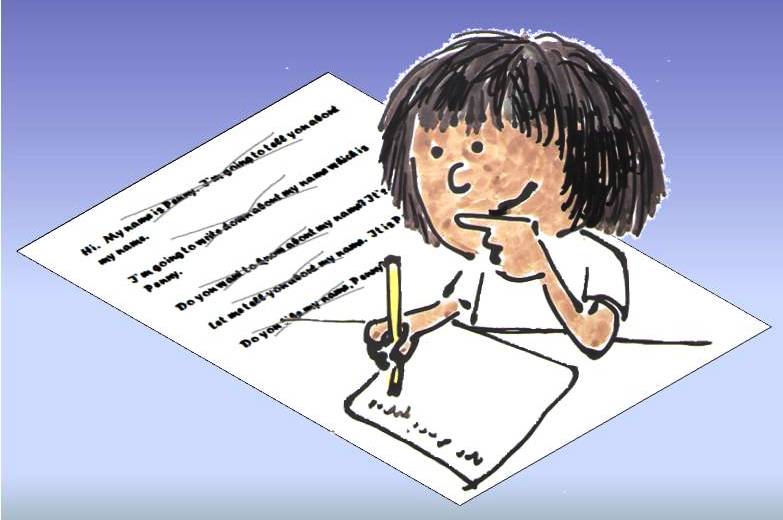
Even with detailed prewriting organizers, many students have no idea how to begin an essay. They stare at that empty notebook page for ten or twenty minutes. Then, in desperation, they either introduce themselves (“Hi. My name is Sid. I’m going to tell you about my pet dog.”) or they write a question (“Do you want to know about my pet dog?”).

Writing introductions can be hard.

When I see a student having difficulty beginning an essay, I suggest several options. “My pet dog just had a litter of puppies. Two of them are black, one is brown and one is spotted. We named the spotted one Spot but we are still thinking about what to name the others.” Or, “Spot is such a dumb name for a dog, but that is what my little sister called one of our new puppies. I wanted to call the puppy ‘Blob’ but my mother said no.” Or, “If you name a puppy, does that mean you get to keep it? My little sister wants to keep one of the puppies from our big dog’s litter, so she named it Spot.”

Sometimes students use one of my suggestions, but more often they modify one of them. I never write down the introduction for them; they need to listen to my suggestions, and write their own introduction. My job is to get them thinking of options. Their job is to write the introduction.

In upcoming blogs, I will talk about various kinds of introductions, but for now I hope to point out how difficult writing an introduction is for some students. Think of it this way: You go to a party and you don’t know anyone. How do you begin a conversation? Do you wait for someone else to start? Do you move around the fringes of groups and listen for a topic you know something about? Do you head for a shadowy corner?

Beginning the essay, even armed with a detailed prewriting organizer, can be daunting. But when students have written a handful of essays, this task usually eases. Sometimes they write an introduction and then call me over to ask my opinion. I see this as a giant step forward for a student since he has taken the initiative to begin.

What if the student writes, “Hi. My name is Sid. I’m going to tell you about my pet dog.” I let it go until later, after the essay is complete. Then I explain that sometimes we need a crutch to begin writing, and that this kind of beginning is a crutch. I say, “What if we cross out ‘Hi. My name is Sid. I’m going to tell you about my dog.’ Instead, what if we start the essay with what comes next?” Almost always what follows is a better beginning, and almost always the student can see that. I have seen students begin essays with “Hi. My name is. . .” and then cross those words out themselves once they understand those words are a crutch they need to use to get themselves going.

And what about boring question beginnings? Students need to know that there is nothing wrong with a question, but it needs to be a question that sparks interest. Instead of, “Do you want to know about my dog?” I help students change the question into one which might get “yes” for an answer. “Do you want to know what it’s like to watch a dog have babies?” “Do you know what a mother dog does right after her puppies are born?” “Do you think having five kids at a time is normal? Well, it is for my dog.”

In our next blog, we will talk about useful types of introductions.